

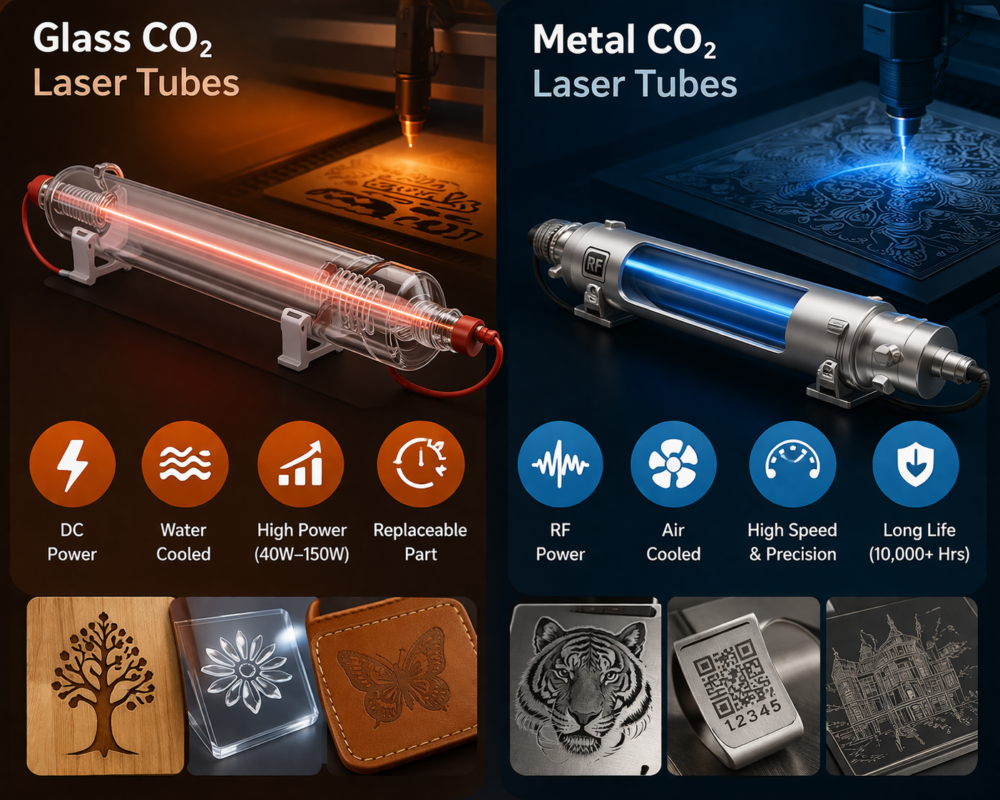
The Glass vs Metal CO2 Laser Tubes debate comes down to what matters most for your work. Glass tubes are usually the better pick when lower cost and light-to-moderate cutting are priorities. In contrast, metal tubes make more sense for faster engraving, finer detail, longer service life, and heavy-duty use.
The right option depends on your budget, workload, cooling setup, and the level of precision you need.
In this guide, we’ll break both down clearly so it’s easier to choose the one that fits your setup
Glass vs Metal CO2 Laser Tubes: Quick Answer
- Which is cheaper? Glass CO2 laser tubes are usually cheaper upfront.
- Which lasts longer? Metal CO2 laser tubes generally last longer.
- Which engraves better? Metal CO2 laser tubes usually deliver better engraving speed and finer detail.
- Which is better for cutting thicker materials? Glass CO2 laser tubes are often better.
- Which is better for production environments? Metal CO2 laser tubes are usually the stronger choice for heavy-duty use
Table of Contents:
- What Are Glass CO2 Laser Tubes?
- What Are Metal CO2 Laser Tubes?
- 6 Practical Differences That Show Up In Real Use
- Glass vs Metal CO2 Laser Tubes: Quick Recap!
- Which CO2 Laser Tube Should You Choose?
- Find The Right CO2 Laser Setup For Your Work
- Frequently Asked Questions
What Are Glass CO2 Laser Tubes?
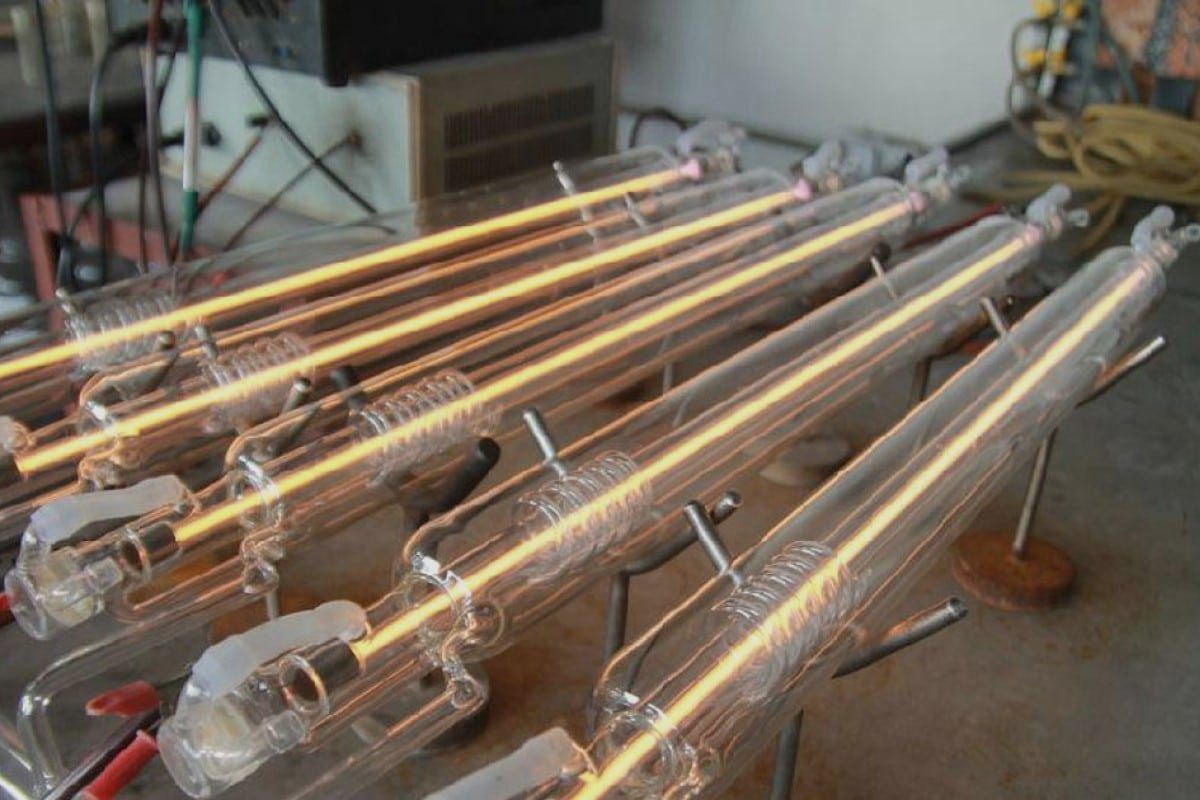
Glass CO2 Laser Tubes are sealed glass tubes filled with a gas mixture that generates the laser beam used in cutting and engraving machines.
They are one of the most common choices for entry-level and mid-range systems because they offer solid cutting power at a lower upfront cost. Here’s what matters most:
- How they work: These tubes use high-voltage DC power to excite the gas inside, creating the laser beam.
- Gas inside the tube: A mixture of carbon dioxide, nitrogen, and helium.
- Cooling needs: Since glass does not handle heat well, these tubes require a water-cooling setup to prevent overheating.
- Power range: They are often available at higher wattages, typically 40W to 150W, making them suitable for cutting work.
- Lifespan: Glass CO2 laser tubes usually have a shorter service life than metal tubes and are often treated as replaceable parts.
- Best use cases: They are widely used for cutting and engraving wood, acrylic, leather, and other non-metal materials.
What Are Metal CO2 Laser Tubes?
Metal CO2 Laser Tubes are sealed tubes that use RF energy to produce a precise, stable laser beam for high-speed cutting and engraving.
They are commonly used in industrial and high-duty setups because they last longer, engrave with finer detail, and need less cooling hardware. Here’s what sets them apart:
- How they work: Metal CO2 laser tubes use radio-frequency energy rather than high-voltage DC power to excite the gas inside the tube.
- Build quality: They are usually made with a sealed metal or ceramic body, which makes them more durable and compact than glass tubes.
- Cooling setup: Most metal CO2 laser tubes are air-cooled, so they typically do not require an external water chiller.
- Speed and precision: These tubes support faster pulsing, making them a strong fit for detailed, high-speed jobs.
- Lifespan: Metal CO2 laser tubes generally last much longer than glass tubes, often running for 10,000 hours or more.
- Maintenance: Some can be recharged or refilled, helping lower long-term replacement costs.
- Best use cases: They are often preferred for industrial work, production setups, and applications where detail and uptime matter.
Fun Fact:
A CO2 laser tube works like the engine of a CO2 Laser Machine. It’s what generates the beam used for cutting and engraving.
6 Practical Differences That Show Up In Real Use
Beyond specs, these are the day-to-day differences that can affect performance, upkeep, and overall ease of use.
| Practical Difference | Glass CO2 Laser Tubes | Metal CO2 Laser Tubes |
|---|---|---|
| Setup involvement | Need more attention during setup because the cooling loop has to be added and monitored | Usually simpler to manage since they do not rely on an external water-cooling loop |
| Handling during transport | More fragile and easier to damage during shipping, handling, or replacement | More rugged in construction and generally easier to handle with less breakage risk |
| Day-to-day monitoring | Operators often need to keep a closer eye on water temperature and flow | Daily operation is usually more straightforward with fewer cooling checks |
| Work interruption risk | More likely to face interruptions if cooling is not maintained properly | Better suited for longer, more stable working sessions with less operator intervention |
| Replacement planning | Usually treated as a replaceable component that may need earlier change-outs | Better suited for buyers who want fewer replacement cycles over time |
| Shop-floor suitability | A workable choice for lighter workflows and smaller-scale use | A stronger fit for demanding setups where consistency matters across longer runs |
Glass vs Metal CO2 Laser Tubes: Quick Recap!
- Glass tubes need more setup and cooling management
- Metal tubes are easier to handle and more durable
- Glass tubes need closer day-to-day monitoring
- Metal tubes run more consistently over long jobs
- Glass tubes may need more frequent replacement
- Metal tubes are better suited for continuous use
💡 Pro Tip: If the machine will be used regularly, look beyond the starting price and consider replacement cycles, cooling needs, and potential downtime. That often gives a clearer picture of which tube is the better fit.
Which CO2 Laser Tube Should You Choose?
The right choice goes beyond specifications. It comes down to how your machine is used in real working conditions. Here’s what you need to know to help align each tube type with your actual needs.
Choose Glass CO2 Laser Tubes If
- Cutting is your main focus
- You’re starting out or working at a smaller scale
- Occasional replacement is manageable
- Your setup allows proper cooling control
Choose Metal CO2 Laser Tubes If…
- You need a stable output for long runs
- Fine detail and precision matter
- You want fewer interruptions
- You prefer a simpler, low-maintenance setup
Find The Right CO2 Laser Setup For Your Work
Choosing between Glass and Metal CO2 Laser Tubes is easier when the machine, application, and workload are considered together. Prakash Laser offers CO2 Laser Machine options built for a range of production needs, from cost-focused setups to high-precision systems.
Here’s what you can expect:
- Guidance based on material, workload, and budget
- Support in comparing glass and metal tube-based setups
- Pricing shared as per the required configuration
Frequently Asked Questions
1. Can glass and metal CO2 laser tubes be used in the same machine?
Not usually. Glass and metal CO2 laser tubes often require different power systems, cooling setups, and machine designs, so they are generally not direct swap-in replacements.
2. Do metal CO2 laser tubes need a water chiller?
No. Metal CO2 laser tubes are commonly air-cooled, while glass tubes usually need water cooling to manage heat.
3. Are glass CO2 laser tubes more fragile during handling?
Yes. Their glass body makes them more vulnerable to breakage during shipping, installation, and replacement than metal alternatives.
4. Do glass and metal laser tubes differ in machine footprint?
Yes. Glass tube systems often require additional space for water-cooling equipment, while metal tube systems can be more compact.
5. Does tube type affect long-run output stability?
Yes. Metal CO2 laser tubes are generally known for more stable output over extended runs, especially in demanding workflows.
One thought on “Glass vs Metal CO2 Laser Tubes: Understanding The Differences”
Comments are closed.