

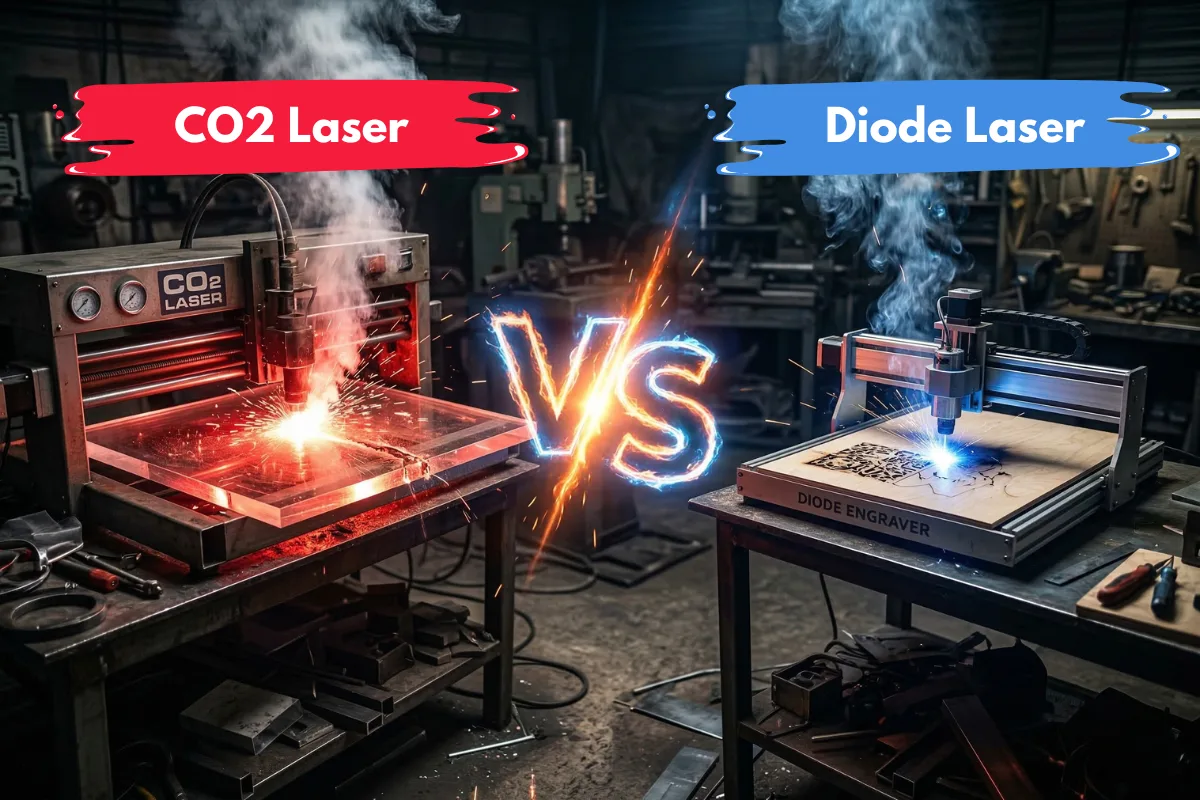
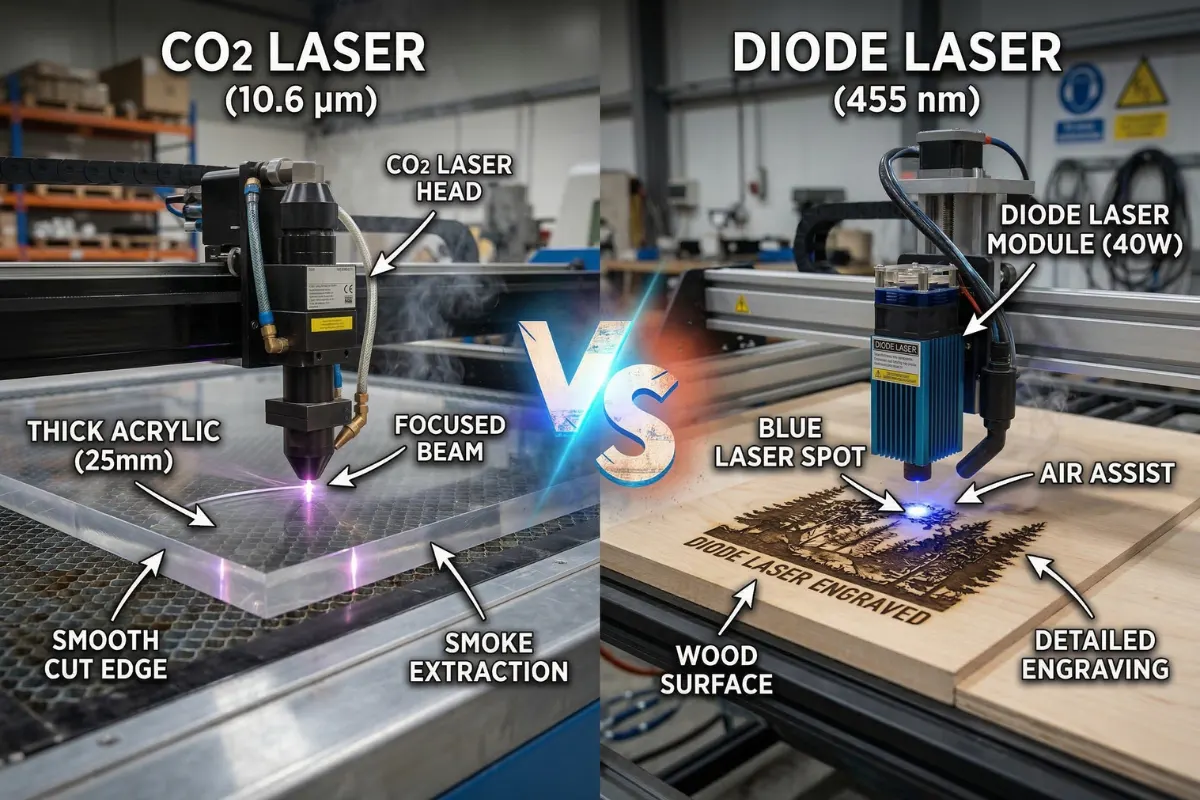
When comparing CO2 Laser vs Diode Laser, the main differences come down to power, wavelength, and what each machine can cut or engrave. A CO2 laser offers higher power for faster, deeper cutting across a wider range of materials, while a diode laser is compact and better suited for engraving and thinner stock. Many people weigh this comparison when choosing between hobby projects and more demanding production work.
This guide covers performance, material compatibility, and cost to help you understand which option makes the most sense for your needs.
Table Of Contents
What Is A CO2 Laser?
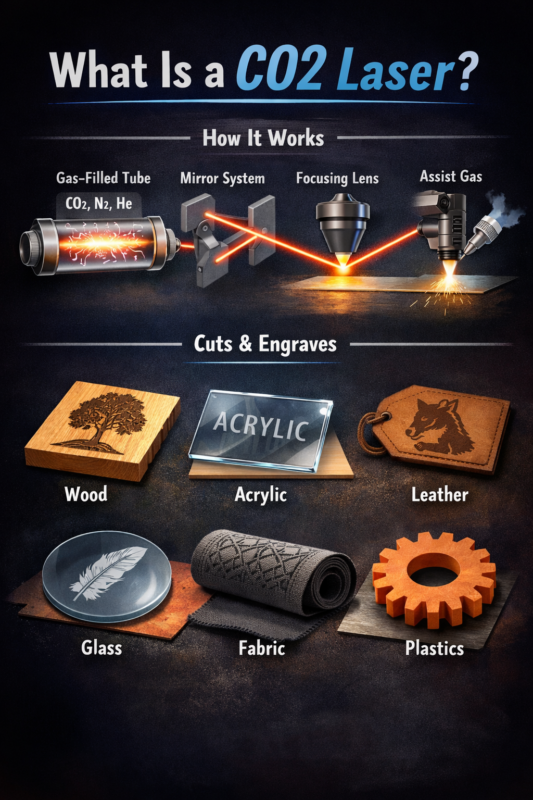
A CO2 Laser Machine is a high-precision cutting and engraving machine that uses a carbon dioxide gas mixture to produce a powerful infrared beam. It’s widely used for cutting and engraving non-metal materials with clean edges and strong detail.
How CO2 Laser Technology Works
- Gas-filled tube: Electricity passes through a sealed tube filled with carbon dioxide, nitrogen, and helium to generate the laser beam.
- Infrared wavelength: The beam operates at a wavelength of around 10,600 nm, which is highly effective on organic materials.
- Mirror guidance system: A series of mirrors directs the beam toward the laser head.
- Focusing lens: The lens concentrates the beam into a very small, high-intensity spot at a precise focal point on the material surface.
- Heat-based removal: The material melts or vaporizes along a CNC-controlled path.
- Assist gas: Air or nitrogen may be used to clear debris and improve edge quality.
What Materials Can a CO2 Laser Cut and Engrave?
CO2 lasers work especially well on:
Read more: How Does A Laser Cutting Machine Work?
What Is A Diode Laser?
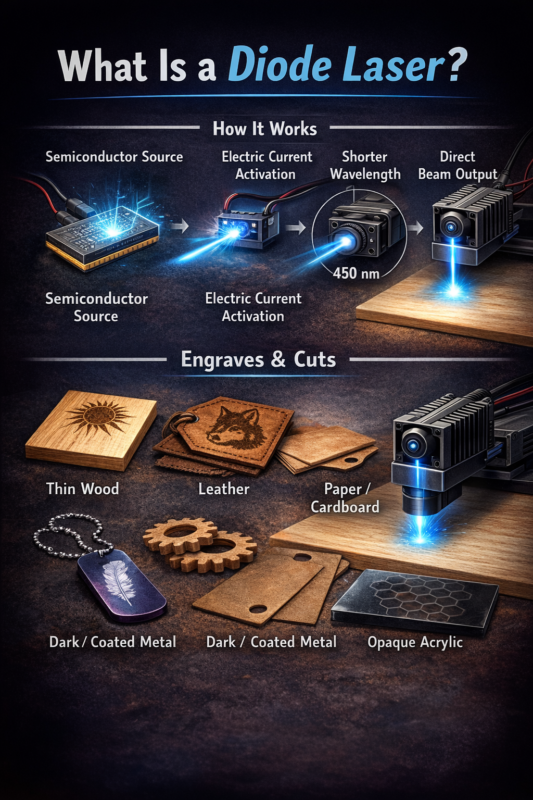
A diode laser is a compact, solid-state laser that produces light using a semiconductor chip rather than a gas-filled tube. It’s widely known for its small footprint, affordable pricing, energy efficiency, and easy setup, making it a popular choice for entry-level and desktop laser systems.
How Diode Laser Technology Works
- Semiconductor source: The laser beam is generated within a tiny chip made of layered semiconductor materials.
- Electric current activation: When electricity passes through the chip, it produces a focused beam of light.
- Shorter wavelength: Most diode engravers use blue light (around 450 nm), which interacts well with many organic materials.
- Direct beam output: Unlike CO2 systems, diode lasers don’t rely on mirror alignment inside a large cabinet.
What Materials Can a Diode Laser Engrave or Cut?
Diode lasers are best suited for:
- Thin wood
- Leather
- Paper and cardboard
- Dark or coated metals (engraving only)
- Some opaque acrylic (limited results)
CO2 Laser vs Diode Laser: A Quick Comparison!
The table below highlights the key differences between Diode and CO2 laser systems, helping you quickly compare their features, performance, and ideal use cases.
| Factors | CO2 Laser | Diode Laser |
| Wavelength | ~10,600 nm (infrared) | ~450 nm (blue light) |
| Primary Use | Cutting and engraving | Mainly engraving, light cutting |
| Materials | Wood, clear acrylic, leather, fabric, glass (engraving), plastics | Thin wood, leather, paper, coated metals (engraving), some opaque acrylic |
| Performance | Higher power (typically 40W–150W+), deeper and faster cuts | Lower power (typically 5W–40W), better for surface engraving |
| Maintenance & Lifespan | Tube replacement required over time; more components | Fewer alignment parts; diode modules generally last longer |
| Cost | Higher upfront investment | More affordable entry price |
| Best For | Small businesses, production work, and thicker materials | Hobbyists, DIY users, light engraving projects |
Which Is Better CO2 or Diode Laser?
It depends on your goals, as each machine has its strengths. Choose a CO2 Laser if you need higher power, faster cutting, and the ability to process thicker materials or clear acrylic. And choose a Diode Laser if you want a lower-cost, compact system, mainly for engraving and cutting thin materials.
In short, CO2 offers more capability. Diodes offer more simplicity and affordability.
What Most Buyers Overlook When Comparing CO2 and Diode Lasers
Beyond power and price, several practical factors can influence your long-term satisfaction when choosing between a CO2 vs Diode Laser system.
- Workspace Needs: CO2 machines require more space and ventilation. Diode lasers fit easily into smaller setups.
- Material Flexibility: CO2 handles more materials with consistent results. Diode systems may require more testing near their limits.
- Upgrade Potential: Diode units sometimes allow modular upgrades. CO2 systems are typically fixed configurations.
- Future Growth: If you plan to work with thicker materials later, starting with CO2 may avoid upgrading too soon.
CO2 Laser vs Diode Laser: At A Glance!
- CO2 laser: Higher power, faster cutting, wider material range
- Diode laser: Compact, affordable, best for engraving and thin materials
- CO2: Better for business use and thicker stock
- Diode: Ideal for hobbyists and entry-level setups
- Bottom line: Choose based on the materials you plan to work with and how much cutting strength you need.
Read more: 10 Important Safety Precautions For Laser Cutting.
Frequently Asked Questions
1. Can a diode laser replace a CO2 laser?
Not in most cases. Diode lasers are suitable for light engraving and thin materials, while CO2 lasers handle thicker materials and clear acrylic more effectively.
2. Do CO2 and diode lasers use the same software?
Many models support similar design file formats (such as SVG or DXF), but machine compatibility depends on the controller and manufacturer.
3. Which laser type is easier to assemble?
Diode lasers often require basic assembly but are generally simpler overall. CO2 machines usually arrive pre-assembled but require proper setup and ventilation.
Read more: 4 Popular Types of Laser Cutting Machines You Should Know
4. Do both lasers require ventilation?
Yes. Both produce smoke and fumes when cutting or engraving, so proper ventilation or an exhaust system is recommended.
5. Which laser consumes more electricity?
CO2 lasers typically consume more power due to higher wattage and cooling systems. Diode lasers are generally more energy-efficient.
6. Can both lasers engrave photos?
Yes, both can engrave images on suitable materials, though engraving speed and depth control may vary depending on the machine’s power.
Read more: A Beginner’s Guide To Photo Engraving On Stainless Steel Using Fiber Laser
7. Is alignment required for both systems?
CO2 lasers require periodic mirror alignment. Diode lasers do not use internal mirrors, so alignment needs are minimal.