

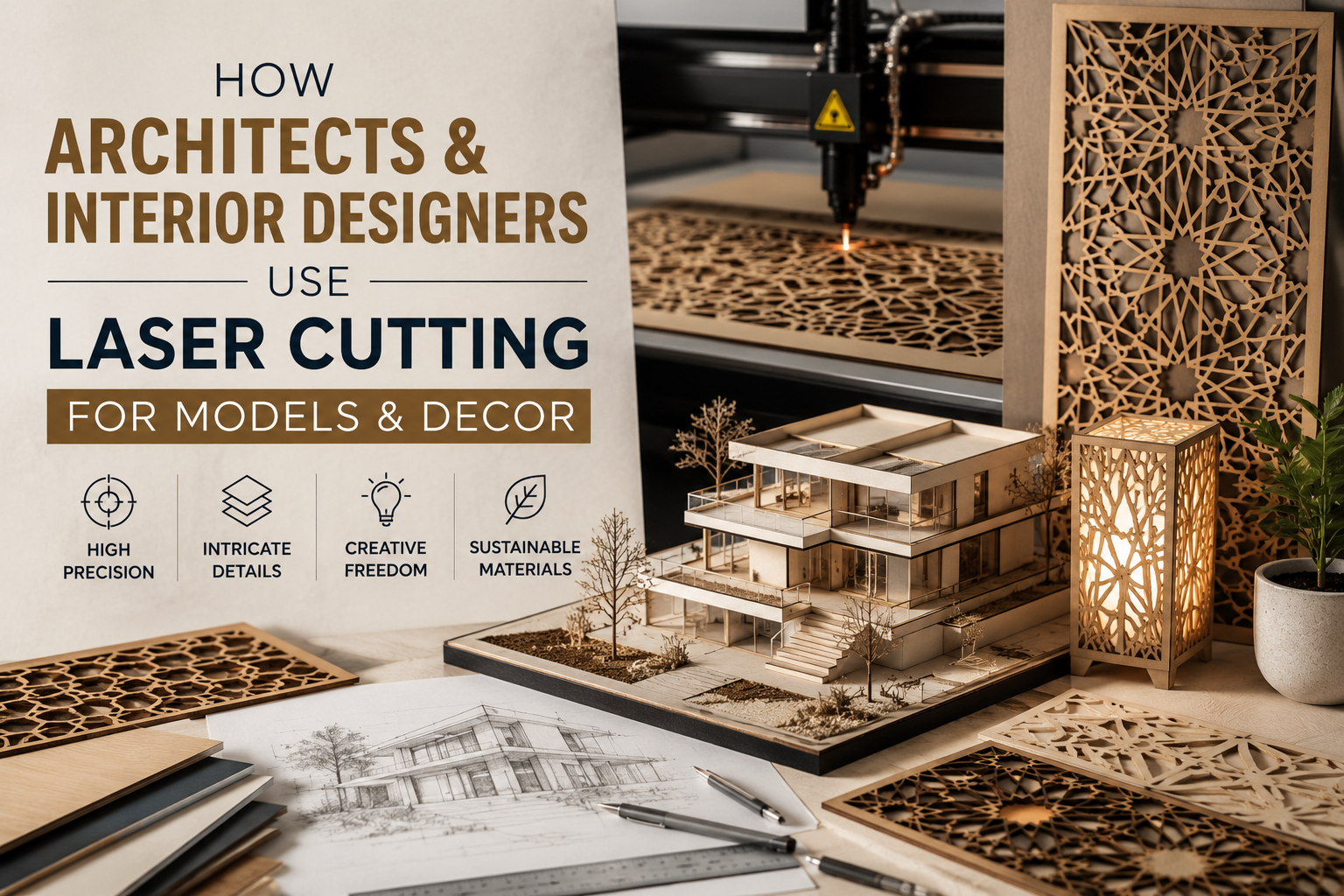
In the world of design, precision is everything. Whether it is a stunning architectural scale model presented to a client or an intricately patterned room divider gracing a luxury penthouse, the quality of craftsmanship speaks louder than any proposal. Today, laser cutting technology has become one of the most powerful tools in the arsenal of architects and interior designers across India — enabling them to create with a level of detail, speed, and consistency that was simply impossible a decade ago.
From laser cutting for interior design India is witnessing a massive wave of adoption, as studios both large and small discover the creative and commercial advantages of integrating laser machines into their workflow. In this blog, we explore exactly how this technology is reshaping design practice — and why machines like Prakash Laser’s CO2 and Fiber Laser Cutting Machines are becoming the preferred choice for design professionals.
1. The Design Revolution: Why Laser Cutting?
Traditional model-making and decor fabrication relied heavily on hand tools, CNC routers, or outsourcing to workshops — all of which meant slow turnaround times, inconsistent quality, and higher costs. Laser cutting changed all of that.
A laser cutting machine operates by directing a high-powered laser beam onto a material surface, precisely cutting or engraving it according to a digital file. The result is clean edges, intricate details, and repeatable accuracy — every single time.
For architects and interior designers, this translates into:
- Faster prototype and model creation
- Complex geometric patterns rendered flawlessly
- Custom decor elements at competitive costs
- On-demand fabrication without minimum order quantities
- The freedom to experiment and iterate designs rapidly
2. Architectural Laser Models: Bringing Blueprints to Life
One of the most impactful applications of laser cutting in architecture is the creation of architectural laser models. These are scale representations of buildings, interiors, or urban landscapes used for client presentations, planning approvals, and design reviews.
Before laser cutting, model-making was painstaking work — carving foam, cutting balsa wood by hand, or relying on expensive model-making firms. Today, an architectural firm can import a CAD drawing directly into laser cutting software and have a precise, professionally finished model ready within hours.
Materials Commonly Used for Architectural Models:
- Acrylic (Perspex): Clean, transparent, and premium-looking. Ideal for modern building models.
- MDF (Medium Density Fibreboard): Affordable and easy to cut. Used for structural elements and layered topography models.
- Cardboard / Foam Board: Lightweight and fast to cut. Great for concept-stage models.
- Wood: Rich texture and finish. Used for high-end presentation models.
- Fabric: For interior design mockups showing upholstery, curtains, or partitions.
Prakash Laser’s CO2 Laser Cutting Machines are particularly well-suited for these materials — cutting and engraving wood, acrylic, MDF, fabric, and more with extreme precision. Whether you need a 1:100 building shell or a detailed interior cross-section, the machine delivers.
3. Laser Cut Decor: From Concept to Installation
Beyond models, laser cut decor is perhaps where the technology has had its most visible impact on interior design. Walk into any contemporary hotel lobby, upscale restaurant, corporate office, or boutique home in India, and you are increasingly likely to find laser-cut elements as a defining part of the aesthetic.
Popular Laser Cut Decor Applications:
- Room Dividers & Partitions: Intricately patterned screens in wood, acrylic, or metal that serve both functional and decorative roles.
- Wall Art & Panels: Custom-designed wall installations with geometric or organic patterns, engraved textures, or brand logos.
- Ceiling Medallions & Cladding: Decorative ceiling elements that add depth and character to living or commercial spaces.
- Furniture Detailing: Laser-engraved table tops, cabinet doors, drawer fronts, and headboards with custom patterns.
- Lighting Fixtures: Lampshades and pendant lights with cut-out patterns that create dramatic shadow effects.
- Signage & Wayfinding: Custom laser-cut signs for offices, hotels, and retail spaces — in acrylic, wood, or metal.
- Window & Door Jalis: Traditional Indian jali patterns reimagined through laser precision, blending culture with modernity.
4. CO2 vs Fiber Laser Cutting Machine: Which Does Interior Designers Need?
When selecting a machine, architects and interior designers often ask: should I choose a CO2 or a Fiber Laser Cutting Machine? The answer depends on the materials you work with most frequently.
CO2 Laser Cutting Machine
Best for non-metal materials — wood, acrylic, MDF, fabric, leather, paper, and cardboard. If your primary work involves model-making and fabricating decorative interior elements, a CO2 laser is the ideal choice. Prakash Laser’s range of CO2 Laser Cutting Machines (Single Head, Double Head, and LC-1325) offers flexible bed sizes and power options to suit different studio scales.
Fiber Laser Cutting Machine
A Fiber Laser Cutting Machine is the go-to when working with metals — stainless steel, aluminium, brass, and copper. Interior designers who create metal art installations, metal signage, custom furniture frames, or architectural facades in steel will benefit greatly from fiber laser technology. Fiber lasers offer faster cutting speeds on metal and a longer lifespan compared to CO2 tubes.
For design studios that work across both material categories, Prakash Laser offers both machine types, enabling a complete in-house fabrication capability.
5. Laser Cutting for Interior Design India: The Growing Adoption
The adoption of laser cutting for interior design in India has accelerated dramatically over the past five years. Several factors are driving this growth:
- Rising demand for custom, one-of-a-kind interiors from affluent homeowners and hospitality brands
- The Make in India push encouraging local fabrication over imports
- Growing awareness of design possibilities through platforms like Pinterest, Houzz, and Instagram
- More affordable machine prices making in-house laser cutting viable even for mid-sized studios
- The expansion of Indian real estate, hospitality, and retail sectors fuelling demand for premium interiors
Cities like Delhi, Mumbai, Bengaluru, Hyderabad, and Ahmedabad are seeing the strongest uptake, with interior design firms investing in in-house laser cutting to protect margins, reduce turnaround time, and differentiate their offerings.
6. Real-World Use Cases: How Indian Design Firms Are Using Laser Cutting
- Luxury Residential Projects: A high-end villa project in Gurugram used laser-cut brass jali screens as room dividers, creating a stunning interplay of light and shadow that became the defining visual of the home.
- Boutique Hotels & Restaurants: Hospitality designers are using laser-cut wooden panels and acrylic lighting fixtures to create signature brand environments that feel handcrafted yet consistent across multiple locations.
- Corporate Offices: Office interior firms are laser-cutting custom reception signage, branded wall art, and decorative ceiling baffles for leading Indian and multinational companies.
- Exhibition Stands & Pop-Ups: Architects designing temporary brand installations for trade shows and pop-up events use laser-cut modular elements that are quick to assemble and visually striking.
- Retail Store Fit-Outs: Fashion and lifestyle retailers are integrating laser-cut display fixtures, perforated wall panels, and custom hangers to create immersive brand environments.
7. Why Choose Prakash Laser for Your Design Studio?
With over 30 years of manufacturing experience and a product range covering CO2 Laser Cutting Machines, Fiber Laser Cutting Machines, Laser Engraving Machines, and Laser Marking Machines, Prakash Laser is one of India’s most trusted names in laser technology.
For architects and interior designers, the key advantages of choosing Prakash Laser include:
- Free sampling before purchase — test your actual materials on our machines
- Wide range of bed sizes to suit different project scales
- Dedicated after-sales support and spare parts availability across India
- Machines designed and tested for Indian operating conditions
- Expert guidance on the right machine for your specific material and application mix
Conclusion
Laser cutting is no longer a niche industrial tool — it is a core design capability that is transforming what architects and interior designers can create, how fast they can create it, and how profitably they can deliver it. From architectural laser models that win client pitches to laser cut decor that defines a space, the applications are as limitless as the designer’s imagination.
If you are an architect, interior designer, or fabricator looking to add a laser cutting machine to your studio, Prakash Laser is here to help you make the right choice. Explore our range of CO2 and Fiber Laser Cutting Machines, or contact our team for a free demo and material sampling today.
📞 Ready to Transform Your Design Studio?
Contact Prakash Laser for a free demo and material sampling.
🌐 www.lasercuttingmachines.co.in | 📧 sale@lasercuttingmachines.co.in | 📱 +91-9871377550