

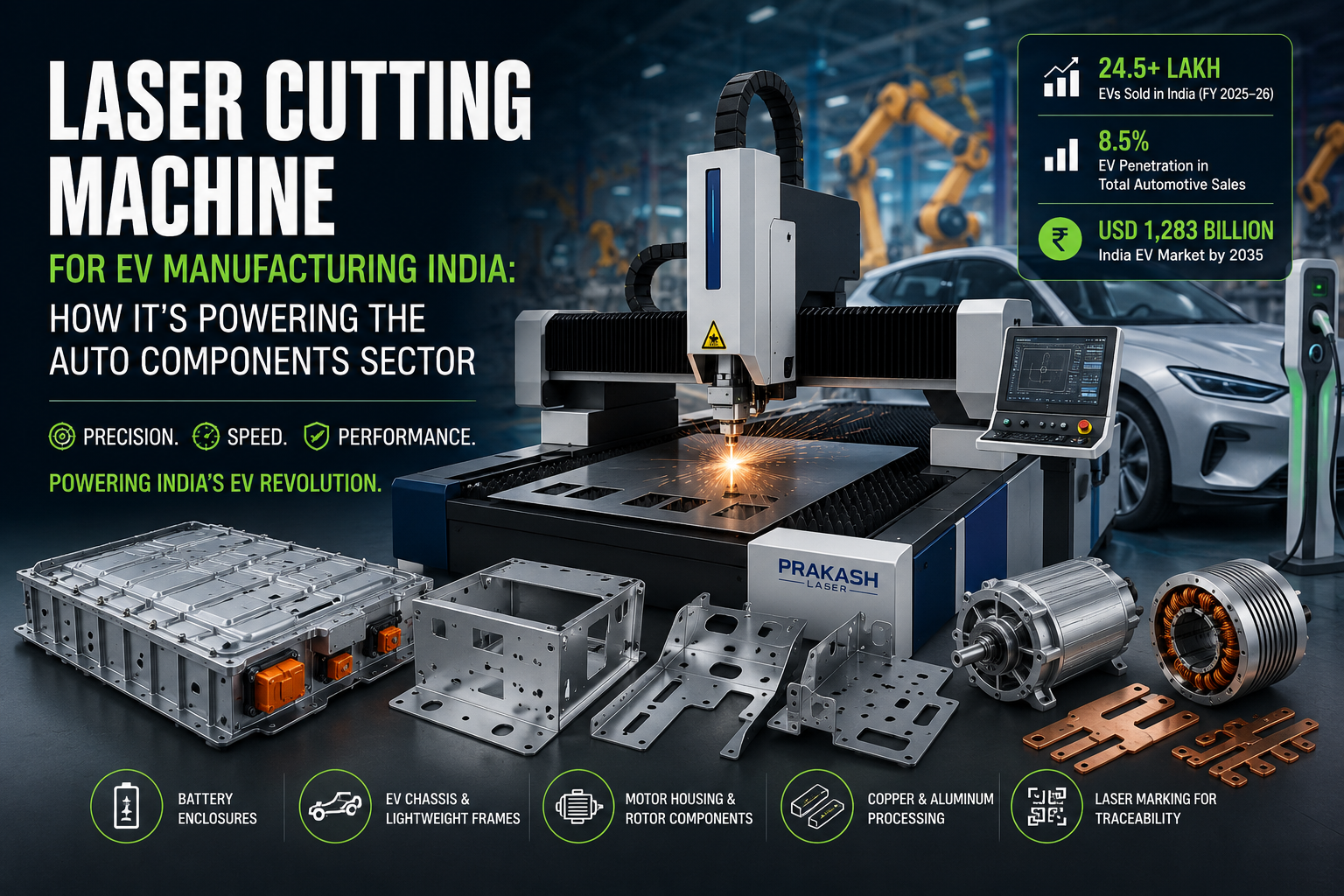
India’s electric vehicle revolution is no longer a distant forecast — it is happening right now, at full speed. In FY 2025–26, India sold over 24.5 lakh electric vehicles, recording a 24.6% year-on-year growth, with EV penetration touching 8.5% of total automotive sales. The India EV market, valued at USD 18.79 billion in 2025, is projected to reach USD 31.09 billion by 2026 and an astonishing USD 1,283 billion by 2035.
Behind this electric surge lies a precision manufacturing revolution — and the demand for a laser cutting machine for EV manufacturing India has never been higher. From cutting battery enclosures to engraving traceability codes on motor components, fiber laser cutting machines and laser marking machines are now the backbone of India’s EV and auto components manufacturing ecosystem. In this blog, we explore exactly how this transformation is unfolding, and why Indian manufacturers — from large OEMs to small auto component suppliers — are rapidly investing in laser technology.
India’s EV Boom: Why Manufacturers Need to Act Now
The Indian government’s FAME India scheme, PM E-DRIVE initiative, and PLI (Production Linked Incentive) scheme have collectively created a powerful push for domestic EV manufacturing. The government has set an ambitious target of 30% EV penetration in private cars, 70% in commercial vehicles, and 80% in two- and three-wheelers by 2030. Tata Motors alone has committed USD 1.5 billion to a domestic battery gigafactory starting production in 2026. Ola Electric commissioned a large-scale battery manufacturing facility in late 2025.
This explosive growth in EV production is creating massive demand for precision manufacturing of auto components — battery packs, motor housings, chassis frames, EV enclosures, wiring harnesses, and more. Traditional manufacturing methods like CNC punching, plasma cutting, or mechanical stamping simply cannot keep pace with the precision, speed, and scalability that EV production demands. This is exactly why a laser cutting machine for EV manufacturing India has become the go-to solution for progressive auto component suppliers.
Why a Laser Cutting Machine for EV Manufacturing India Is Non-Negotiable
Electric vehicles are fundamentally different from internal combustion engine (ICE) vehicles in their component architecture. EV components require:
- Ultra-precise cuts with tolerances measured in microns
- Minimal heat distortion to protect sensitive battery and electronic parts
- Versatility across materials — from high-strength steel and aluminum to copper and titanium
- High repeatability for large-scale production lines
- Traceability and compliance marking on every critical component
Conventional cutting methods fail on most of these parameters. A fiber laser cutting machine, by contrast, delivers a contactless, non-abrasive cutting process that generates minimal heat, produces clean edges, reduces material waste, and integrates seamlessly into automated production lines. This makes investing in a laser cutting machine for EV manufacturing India not just preferable — it is indispensable for any manufacturer looking to supply into the EV value chain.
Key Applications of Laser Cutting Machines in EV & Auto Component Production
1. Battery Enclosure & Pack Manufacturing
The battery pack is the most critical and cost-intensive component of any EV. Battery enclosures — typically made from aluminum or high-strength steel — must be cut with extreme precision to ensure structural integrity, thermal management, and waterproofing.
Fiber laser cutting machines excel here because they handle aluminum with high efficiency due to the high absorption rate of fiber laser beams. Whether it is a single battery cell housing or a large battery tray for a passenger EV, laser cutting ensures dimensional accuracy, clean edges without burrs, and zero material deformation. This is especially critical for electric car battery manufacturing, where even minor tolerances can affect safety and performance.
2. EV Chassis and Lightweight Frame Fabrication
India’s EV manufacturers are increasingly shifting toward lightweight vehicle architectures to extend driving range — a key purchase decision driver for Indian consumers. Aluminum, advanced high-strength steel (AHSS), and composites are replacing heavier traditional materials in chassis and frame construction.
High-power fiber laser cutting machines — now available in configurations up to 6kW, 12kW, and beyond — cut through thick metal sheets of these advanced materials with impressive speed and zero compromise on quality. The ability to handle 2D laser cutting for flat chassis panels as well as complex curved geometries makes fiber laser technology the preferred choice for India’s growing EV OEMs including Tata Motors, Mahindra Electric, and Ather Energy.
3. Motor Housing and Rotor Component Cutting
Electric motors — whether BLDC (Brushless DC), PMSM (Permanent Magnet Synchronous Motor), or hub motors — require precision-cut housings and rotor laminations. These components demand tight tolerances and smooth surface finishes that mechanical cutting methods cannot consistently deliver at scale.
CO2 and fiber laser cutting machines used in motor component manufacturing ensure that each part is identical, reducing the need for post-processing and secondary finishing. As India’s EV motor market grows at a CAGR of 17.9% through 2034, the demand for precision motor component cutting will only accelerate — making a laser cutting machine for EV manufacturing India a long-term, high-return investment.
4. Copper and Aluminum Component Processing
EV powertrains use large quantities of copper — in winding coils, bus bars, connectors, and thermal management components — and aluminum in heat sinks and structural parts. Cutting copper and aluminum with conventional methods often leads to edge burrs, heat distortion, and material wastage.
Fiber laser cutting machines are particularly effective on both copper and aluminum due to their wavelength characteristics, delivering clean, burr-free edges with minimal wastage. For Indian auto component suppliers exporting to global EV manufacturers, this level of quality consistency is critical for meeting international standards.
5. Sheet Metal Auto Parts: Brackets, Clamps & Fasteners
Even beyond core EV components, India’s auto component industry — which is targeting USD 100 billion in exports by 2030 — relies heavily on laser cutting for producing brackets, clamps, fasteners, and structural panels. A CNC laser cutting machine ensures that each part meets dimensional accuracy requirements, reducing rejection rates and rework costs dramatically.
The integration of IoT-enabled laser cutting machines into auto component production lines allows real-time monitoring, predictive maintenance, and quality control — all of which help Indian manufacturers achieve the consistency demanded by global automotive OEMs.
6. Airbag Fabric and Interior Component Cutting
Beyond metal components, EVs also require precision cutting of non-metal materials. Airbag fabric, seating material, dashboard panels, and interior trim components must be cut with high accuracy and clean edges. CO2 laser cutting machines are ideally suited for cutting these fabric and polymer-based components, eliminating the need for blade replacement and reducing setup times significantly.
Laser Marking Machines: The Unsung Hero of EV Component Traceability
In EV manufacturing, every component must be traceable throughout its lifecycle — from production to warranty management to recycling. Regulatory compliance, anti-counterfeiting, and quality assurance all depend on permanent, readable markings on each part.
Fiber laser marking machines and UV laser marking machines enable manufacturers to engrave:
- Unique serial numbers and QR codes on battery cells and packs
- BIS compliance marks and safety certifications on electrical components
- Date codes, batch numbers, and part identifiers on motor components
- Anti-counterfeit marks on high-value EV parts
Unlike ink-based printing or mechanical engraving, laser marking is permanent, tamper-proof, and does not damage the surface integrity of the component. As India tightens its EV component quality and traceability standards, laser marking for auto components is becoming a regulatory necessity, not just a best practice.
Fiber Laser vs CO2 Laser for EV Applications: Which to Choose?
Indian manufacturers often face a choice between fiber and CO2 laser systems when investing in a laser cutting machine for EV manufacturing India. Here is a quick comparison for auto component applications:
| Parameter | Fiber Laser Cutting Machine | CO2 Laser Cutting Machine |
|---|---|---|
| Best for | Metals (steel, aluminum, copper) | Non-metals, thin metals, acrylics |
| Energy Efficiency | Very High | Moderate |
| Cutting Speed | Very Fast | Moderate |
| Reflective Metals | Excellent | Not Suitable |
| Maintenance | Low (no gas tube) | Higher (tube replacement) |
| Ideal EV Application | Battery enclosures, chassis, motor parts | Interior trim, airbag fabric, gaskets |
For most EV auto component manufacturers in India, a high-power fiber laser cutting machine is the primary workhorse, while a CO2 machine handles non-metallic components. Many manufacturers invest in both to cover the full spectrum of EV part production.
The Make in India Advantage: Why Choose a Local Laser Machine Manufacturer
Importing laser cutting machines from China or Europe is expensive, involves long lead times, and creates challenges around after-sales support and spare parts availability. With India’s Make in India initiative actively pushing for domestic manufacturing, partnering with an Indian laser cutting machine manufacturer offers significant advantages:
- Lower machine costs without import duties
- Faster delivery and installation
- On-site technical support and training
- Easy availability of laser spare parts across India
- Machines designed for Indian power conditions and workflows
Prakash Laser, with over 30 years of manufacturing experience, offers a complete range of fiber laser cutting machines, CO2 laser cutting machines, and fiber laser marking machines — all designed to meet the precision requirements of EV and auto component manufacturers across India.
What to Look for When Buying a Laser Cutting Machine for EV Manufacturing India
If you are an auto component manufacturer or EV parts supplier evaluating your options, here are the key parameters to assess:
1. Laser Power (Wattage): For cutting steel or aluminum sheets between 2mm and 12mm — the most common range in auto component manufacturing — machines in the 3kW to 6kW range deliver the best balance of speed and quality. For thicker profiles, 12kW and above may be needed.
2. Bed Size: Standard auto component cutting typically requires a 1500mm x 3000mm or 2000mm x 4000mm work area to handle full sheet sizes efficiently.
3. Automation Compatibility: Look for machines that integrate with automated loading/unloading systems and robotic arms for high-volume EV production lines.
4. After-Sales Support: Machine downtime is money lost. Choose a manufacturer with a proven after-sales network and spare parts availability across India.
5. Software and Control System: A user-friendly CNC control system with nesting software is critical to minimize material waste and maximize cutting efficiency.
The Road Ahead: Laser Cutting and India’s EV Future
India’s EV sector is on a trajectory that will reshape the entire auto component ecosystem. With Tata Motors, Mahindra Electric, Ola Electric, Ather Energy, and dozens of new EV startups scaling production, the demand for precision-manufactured components will grow exponentially through 2030 and beyond.
The India Laser Market, valued at USD 1.83 billion in 2025, is expected to reach USD 4.23 billion by 2030 at a CAGR of 18.2%. A significant share of this growth will be driven directly by the EV and auto components sector.
Whether you are a large-scale OEM supplier or a mid-sized workshop looking to enter the EV space, investing in the right laser cutting machine for EV manufacturing India today positions your business at the forefront of the country’s most exciting industrial transformation. The manufacturers who act now will be the ones supplying the EVs of tomorrow.
Ready to Invest in a Laser Cutting Machine for EV Manufacturing in India?
At Prakash Laser, we manufacture a complete range of laser solutions specifically suited for EV and auto component applications — from high-power fiber laser cutting machines for metal fabrication to fiber laser marking machines for component traceability.
Contact us today to discuss your manufacturing requirements, request a free sample cutting demonstration, or get a customized quote.
📞 +91-9871377550 📧 sale@lasercuttingmachines.co.in 🌐 www.lasercuttingmachines.co.in