

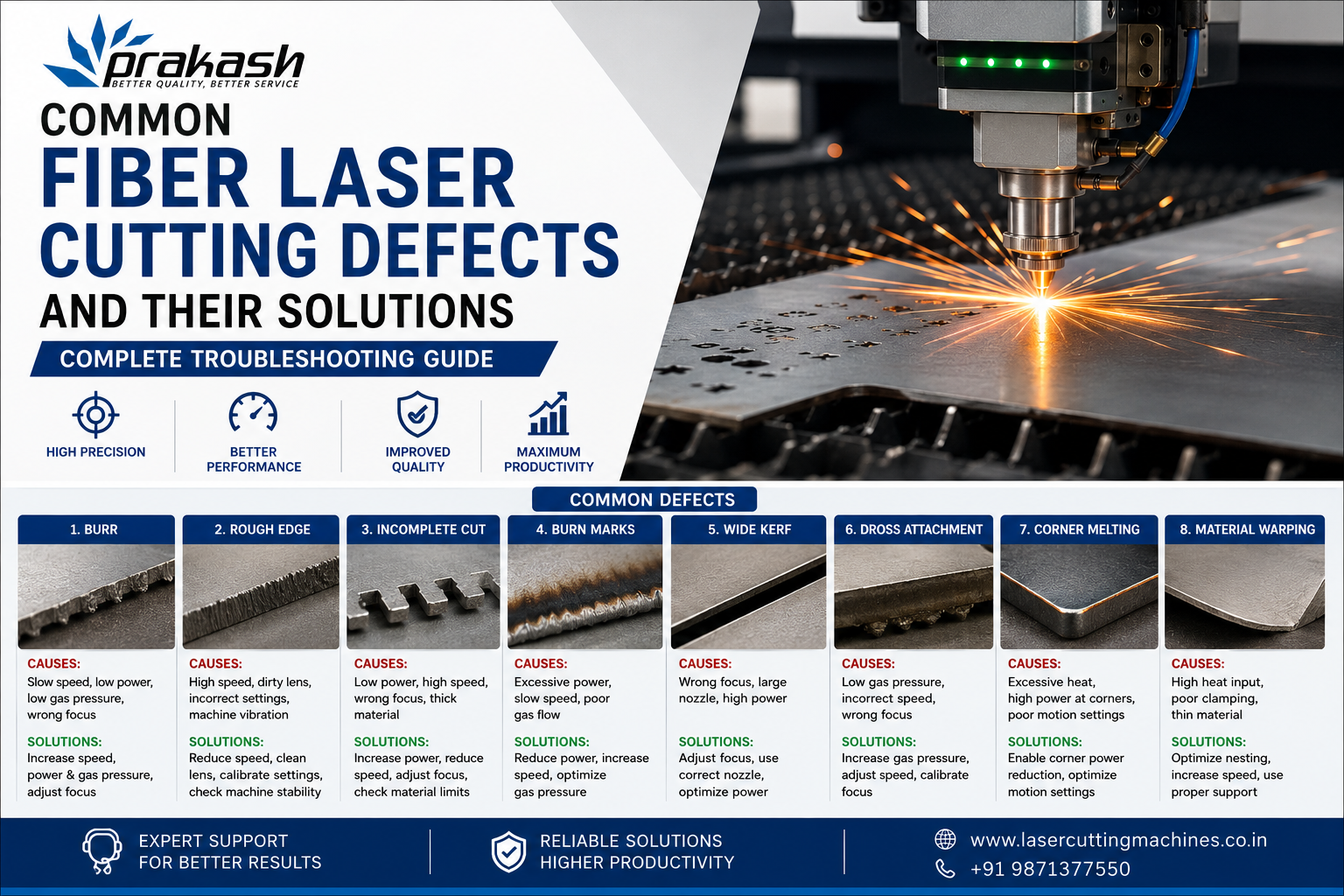
Common Fiber Laser Cutting Defects can significantly impact production quality, increase material wastage, and reduce manufacturing efficiency. While modern fiber laser cutting machines offer unmatched precision and speed, improper machine settings, poor maintenance, or incorrect material handling can lead to various cutting defects.
Understanding these common fiber laser cutting defects and their solutions is essential for manufacturers, fabrication companies, and sheet metal processing industries looking to maintain superior cut quality and maximize productivity.
In this comprehensive guide, we will discuss the most common fiber laser cutting defects, their causes, troubleshooting methods, and preventive measures to help you achieve flawless cutting results.
What Are Common Fiber Laser Cutting Defects?
Common Fiber Laser Cutting Defects refer to imperfections that occur during the laser cutting process and affect the quality, accuracy, and appearance of the final product.
These defects can include:
- Burr formation
- Rough cut edges
- Incomplete cutting
- Burn marks
- Dross attachment
- Wide kerf width
- Corner melting
- Material warping
Identifying these defects early can help manufacturers reduce scrap rates and improve operational efficiency.
Why Do Common Fiber Laser Cutting Defects Occur?
Several factors contribute to common fiber laser cutting defects, including:
- Incorrect laser power settings
- Improper cutting speed
- Wrong focus position
- Poor assist gas pressure
- Dirty lenses
- Damaged nozzles
- Low-quality materials
- Lack of machine maintenance
Optimizing these parameters is crucial for achieving clean and accurate cuts.
Common Fiber Laser Cutting Defects: Burr Formation and Solutions
What Is Burr Formation?
Burrs are unwanted metal projections that remain attached to the bottom edge of the cut material.
Causes of Burr Formation
- Low laser power
- Slow cutting speed
- Incorrect focal position
- Low assist gas pressure
- Damaged nozzle
Solutions
✔ Increase laser power
✔ Optimize cutting speed
✔ Adjust focus position accurately
✔ Maintain proper gas pressure
✔ Replace worn-out nozzles
Impact
Burr formation increases finishing costs and requires additional grinding or deburring operations.
Common Fiber Laser Cutting Defects: Rough Cut Edges and Solutions
What Are Rough Cut Edges?
Rough edges appear when the cut surface becomes uneven, wavy, or jagged.
Causes
- Excessive cutting speed
- Contaminated lens
- Incorrect focus settings
- Machine vibrations
Solutions
✔ Reduce cutting speed
✔ Clean optical lenses regularly
✔ Calibrate focus position
✔ Check guide rails and machine stability
Impact
Rough edges reduce product quality and complicate welding and assembly operations.
Common Fiber Laser Cutting Defects: Incomplete Cutting Problems
What Is Incomplete Cutting?
Incomplete cutting occurs when the laser beam fails to fully penetrate the material.
Causes
- Insufficient laser power
- Excessive speed
- Wrong focus point
- Material thickness exceeding machine capacity
Solutions
✔ Increase power output
✔ Reduce cutting speed
✔ Reposition focus point
✔ Verify machine capability for material thickness
Impact
Incomplete cuts lead to material waste and production delays.
Common Fiber Laser Cutting Defects: Burn Marks and Overheating Issues
What Are Burn Marks?
Burn marks appear as dark discoloration or excessive heat-affected zones around the cut edge.
Causes
- Excessive laser power
- Slow cutting speed
- Poor gas flow
Solutions
✔ Reduce laser power
✔ Increase cutting speed
✔ Optimize assist gas pressure
Impact
Burn marks reduce aesthetic quality and may require secondary finishing processes.
Common Fiber Laser Cutting Defects: Wide Kerf Width Problems
What Is Wide Kerf Width?
Kerf width refers to the amount of material removed during cutting. Excessively wide kerfs affect precision.
Causes
- Incorrect focus position
- Large nozzle diameter
- Excessive power settings
Solutions
✔ Fine-tune focus position
✔ Select appropriate nozzle size
✔ Optimize cutting parameters
Impact
Wide kerf widths reduce dimensional accuracy and increase material loss.
Common Fiber Laser Cutting Defects: Dross Attachment Solutions
What Is Dross Attachment?
Dross attachment occurs when molten material solidifies and sticks to the bottom of the cut.
Causes
- Low gas pressure
- Incorrect cutting speed
- Poor focus settings
Solutions
✔ Increase assist gas pressure
✔ Optimize cutting speed
✔ Adjust focus calibration
Impact
Dross increases cleaning time and lowers production efficiency.
Common Fiber Laser Cutting Defects: Corner Melting Issues
What Is Corner Melting?
Corner melting occurs when excessive heat accumulates at sharp corners during cutting.
Causes
- High laser power
- Poor motion control settings
- Slow corner speed
Solutions
✔ Enable corner power reduction
✔ Optimize acceleration settings
✔ Improve cutting path programming
Impact
Corner melting reduces precision and affects product appearance.
Common Fiber Laser Cutting Defects: Material Warping Problems
What Is Material Warping?
Material warping refers to distortion or bending of metal sheets during cutting.
Causes
- Excessive heat input
- Thin sheet materials
- Improper clamping
Solutions
✔ Increase cutting speed
✔ Improve sheet support
✔ Use proper nesting strategies
✔ Ensure secure clamping
Impact
Warped components often become unusable and increase scrap rates.
How to Prevent Common Fiber Laser Cutting Defects
Preventing common fiber laser cutting defects is easier and more cost-effective than correcting them after production.
Daily Maintenance Checklist
- Clean protective lenses
- Inspect nozzles
- Check gas supply
- Verify focus calibration
Weekly Maintenance Checklist
- Clean guide rails
- Check cooling systems
- Inspect cutting head alignment
Monthly Maintenance Checklist
- Verify machine accuracy
- Inspect optical components
- Review machine performance reports
Regular maintenance can reduce cutting defects by up to 70% and improve machine lifespan.
Choosing the Right Machine to Avoid Common Fiber Laser Cutting Defects
The quality of your fiber laser cutting machine plays a major role in minimizing common fiber laser cutting defects.
Advanced fiber laser machines offer:
- Intelligent auto-focus systems
- Automatic nozzle calibration
- Real-time process monitoring
- Smart cutting databases
- Precision motion control
These technologies ensure superior cut quality and consistent production performance.
Why Manufacturers Trust Prakash Laser
Prakash Laser is one of India’s leading manufacturers of advanced Fiber Laser Cutting Machines designed for high precision, reliability, and productivity.
Our Key Advantages
✔ High-speed metal cutting
✔ Superior edge quality
✔ Low operating costs
✔ Smart automation features
✔ Excellent technical support
✔ Custom solutions for fabrication industries
Our fiber laser cutting machines are ideal for stainless steel, mild steel, aluminum, brass, copper, and various industrial applications.
Conclusion
Common Fiber Laser Cutting Defects such as burr formation, rough edges, incomplete cuts, burn marks, dross attachment, corner melting, and material warping can significantly affect manufacturing efficiency and product quality.
By understanding the causes of these common fiber laser cutting defects and implementing the right troubleshooting methods, manufacturers can reduce waste, improve productivity, and achieve consistently high-quality cutting results.
Investing in advanced fiber laser cutting technology and following a proactive maintenance schedule is the best way to eliminate cutting defects and maximize profitability.
Looking for a reliable Fiber Laser Cutting Machine?
Contact Prakash Laser today to discover advanced laser cutting solutions engineered for modern manufacturing industries.
📞 +91 9871377550
🌐 www.lasercuttingmachines.co.in
Frequently Asked Questions (FAQs)
What are the most common fiber laser cutting defects?
The most common fiber laser cutting defects include burr formation, rough edges, dross attachment, burn marks, incomplete cuts, wide kerf width, corner melting, and material warping.
How can I reduce burr formation in fiber laser cutting?
You can reduce burr formation by optimizing cutting speed, increasing assist gas pressure, adjusting focus position, and ensuring proper laser power settings.
Why does dross form during fiber laser cutting?
Dross usually forms due to low gas pressure, improper focus settings, or incorrect cutting speeds.
What causes rough edges in laser cutting?
Rough edges are often caused by excessive cutting speed, dirty lenses, poor focus calibration, or machine vibrations.
How do I improve cut quality in a fiber laser cutting machine?
Regular maintenance, proper parameter optimization, clean optics, and high-quality materials can significantly improve cut quality.