

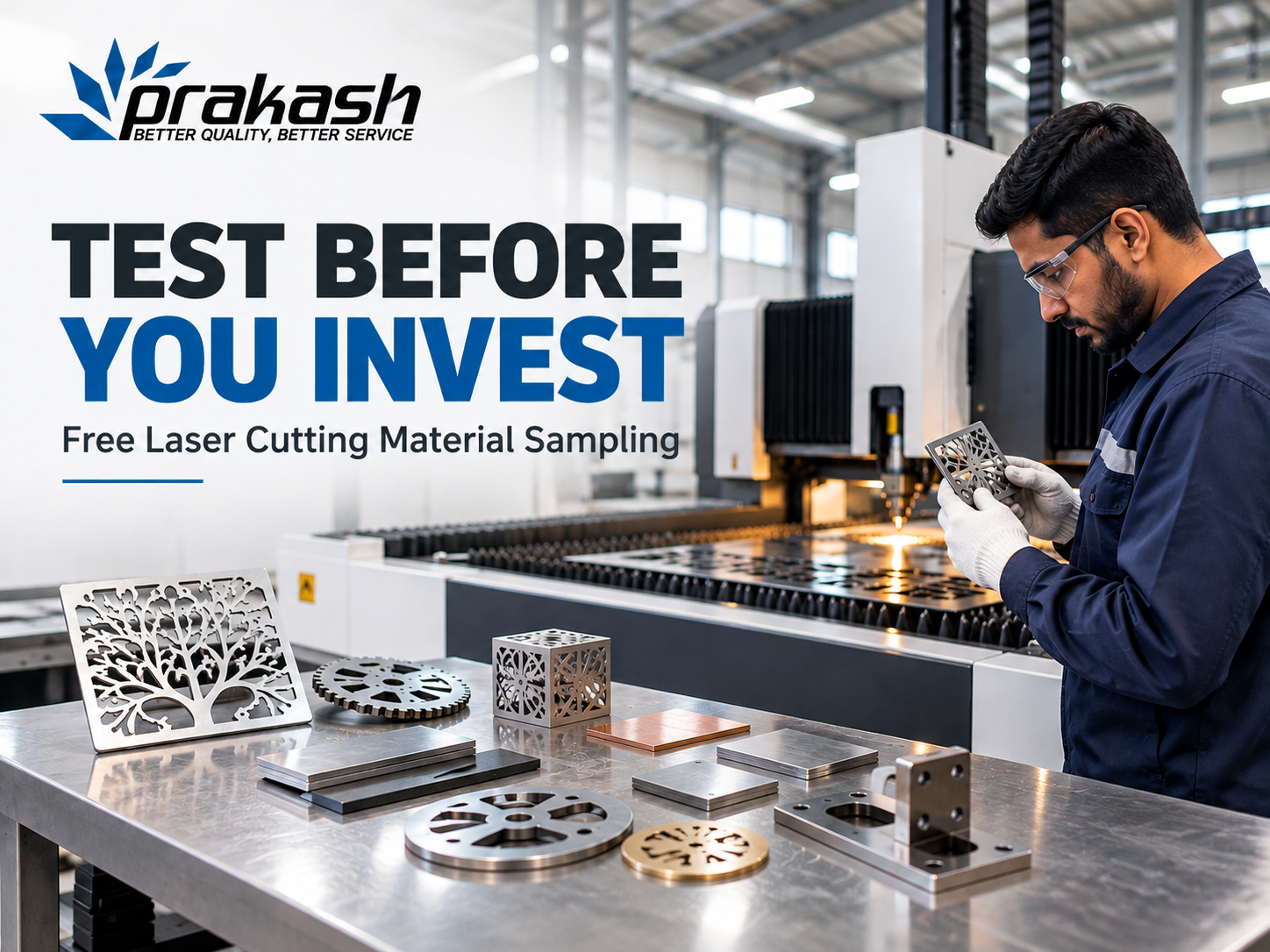
Buying a laser cutting machine is an important investment for any manufacturing business. Whether you work in signage, acrylic fabrication, furniture manufacturing, metal processing, packaging, or industrial component production, the machine you choose can directly affect product quality, production efficiency, operating costs, and profitability.
However, selecting the right machine is not always straightforward. Different materials respond differently to laser processing, and the results depend on several factors, including laser technology, power, working area, material thickness, cutting speed, focusing, and machine configuration.
This is where laser cutting machine material sampling becomes valuable.
Free material sampling allows prospective buyers to evaluate how a laser machine processes their actual materials before making a purchase decision. Instead of relying entirely on product specifications or demonstrations using unfamiliar materials, buyers can examine real samples and make a more informed comparison.
In this guide, we explain how free laser cutting sample testing works, what you should evaluate, and how it can help you choose the right laser cutting or engraving machine for your business.
What Is Free Material Sampling in Laser Cutting?
Free material sampling is a process in which a laser machine manufacturer or supplier tests a customer’s material using a suitable machine and shares the resulting sample for evaluation.
For example, a signage manufacturer may want to cut acrylic sheets, while a furniture manufacturer may need to process MDF or plywood. A metal fabrication company may want to test stainless steel, mild steel, or other compatible metals using an appropriate fiber laser cutting system.
Rather than purchasing a machine based only on specifications, the buyer can request a sample to understand how the material performs under suitable processing conditions.
Depending on the manufacturer and testing arrangement, the process may include:
- Reviewing the material type, grade, and thickness.
- Understanding the intended cutting or engraving application.
- Selecting a suitable laser machine and configuration.
- Testing appropriate processing parameters.
- Producing a sample for visual and dimensional inspection.
- Discussing the results, machine requirements, and next steps.
Availability, testing conditions, sample delivery, and charges should be confirmed with the manufacturer in advance. Buyers should also verify whether their specific material is suitable for laser processing.
Why Is Material Sampling Important Before Buying a Laser Cutting Machine?
A machine may appear suitable on paper but still fail to meet a business’s actual production requirements. Material sampling helps bridge the gap between technical specifications and practical performance.
1. Evaluate Cutting Quality Before Investing
Cutting quality is one of the first things buyers should examine when selecting a laser cutting machine.
Depending on the material and application, important factors may include edge smoothness, dimensional accuracy, corner quality, fine-detail reproduction, surface marks, and the amount of finishing required after cutting.
For example, a business manufacturing acrylic signage may require clean edges and precise lettering. A company producing industrial components may place greater importance on dimensional tolerances, repeatability, and edge condition.
A sample produced using your material allows you to inspect these characteristics directly.
It also helps you identify whether the proposed machine can meet your application requirements or whether different optics, power, settings, or machine configurations need to be considered.
2. Find the Right Laser Technology for Your Material
Not every laser cutting machine is designed for the same materials.
CO2 laser cutting machines are commonly used for suitable non-metallic materials such as acrylic, wood, MDF, leather, and certain fabrics. Fiber laser cutting machines are widely used for metal-processing applications, including suitable grades and thicknesses of steel, aluminium, and other metals.
The appropriate choice depends on the material, its composition, thickness, desired result, and production requirements.
A material sampling test helps buyers discuss these requirements with the manufacturer before choosing a machine.
For instance, a business primarily cutting acrylic and MDF may need a different solution from a fabrication unit processing metal sheets. Testing the actual application can help narrow down the available options and avoid selecting a machine based on an unsuitable comparison.
3. Check Whether the Machine Can Handle Your Material Thickness
Material thickness affects cutting performance, processing speed, edge quality, and the suitability of a particular machine configuration.
A buyer working with thin acrylic sheets may have different requirements from a manufacturer processing thicker wooden panels or metal plates.
During material sampling, specify the actual thicknesses you expect to process. If your production involves several thicknesses, request separate tests where appropriate.
Ask the manufacturer to document the machine configuration and settings used during the test. This helps you understand whether the demonstrated result is relevant to your everyday production requirements.
Remember that a successful sample at one thickness does not automatically guarantee equivalent performance at every other thickness.
4. Understand Realistic Cutting Speed and Productivity
Production speed is another important factor when evaluating a laser cutting machine.
However, advertised maximum speed does not necessarily represent the speed at which a machine will produce acceptable finished components. Actual performance can vary with material type, thickness, geometry, laser power, cutting parameters, and the number of small details in a design.
A material sampling demonstration can help you discuss realistic production expectations with the supplier.
Where possible, ask for a timed test using a representative design rather than a simple straight-line cut. A complex design containing curves, corners, holes, and small features may provide a more useful indication of practical processing requirements.
Use the results to estimate production capacity, but account for loading, unloading, material handling, setup, and finishing when calculating overall productivity.
5. Identify Potential Material Waste and Finishing Requirements
Material waste can affect manufacturing costs, particularly when processing expensive sheets or producing large batches.
During a sample evaluation, inspect the cut components for unwanted marks, damaged edges, dimensional errors, and other defects relevant to your application.
For suitable materials, also assess whether the sample requires cleaning, polishing, sanding, or another finishing process.
Discuss nesting, kerf width, part spacing, and design layout with the supplier where relevant. These factors can influence how efficiently material is used.
The purpose is not simply to produce one attractive sample. It is to understand how the machine could perform within your actual manufacturing workflow.
6. Make a More Informed Investment Decision
The price of a laser cutting machine is only one part of the purchasing decision.
Buyers should also consider installation, operator training, electricity consumption, consumables, maintenance, software, extraction requirements, and after-sales support.
Material sampling provides practical evidence that can support the investment evaluation. It allows you to compare the quality of the output with your business requirements and identify questions that need to be answered before placing an order.
For example, if two machines produce similar results on your material, you can compare their operating requirements, productivity, service arrangements, warranty, and total cost of ownership.
This makes the decision more comprehensive than choosing a machine solely because it has a lower purchase price or a higher advertised speed.
Which Materials Should You Test Before Buying a Laser Machine?
The materials you test should reflect the products you intend to manufacture.
Acrylic
Acrylic is commonly used for signage, displays, decorative products, and lettering. Buyers may evaluate edge appearance, fine-detail accuracy, and the quality of cut shapes.
MDF and Wood
Furniture, decorative panels, craft products, and interior components may require accurate cutting and repeatable results. Test the actual board type and thickness you plan to use.
Wood and engineered boards can have different compositions and processing characteristics, so results should not be assumed to be identical across all grades.
Leather and Suitable Fabrics
Manufacturers producing fashion accessories, upholstery components, or textile products may need to evaluate cutting precision, intricate patterns, and the condition of the surrounding material.
Material composition, coatings, and treatments must be checked for laser compatibility before testing.
Stainless Steel and Mild Steel
Metal fabricators should evaluate samples made from the actual metal grade and thickness they expect to process.
Important considerations include dimensional accuracy, edge condition, piercing performance, cutting consistency, and the suitability of the proposed fiber laser configuration.
Other Materials
Depending on the machine and application, buyers may also investigate compatible plastics, paper-based materials, coated surfaces, and other substrates.
Always disclose the material’s composition and any coatings or treatments before testing. Some materials, including PVC and certain halogen-containing plastics, can release hazardous or corrosive gases when exposed to a laser and should not be processed without a verified safety assessment and appropriate controls.
How to Get the Most Value From a Free Laser Cutting Sample
To make the test meaningful, provide the manufacturer with accurate information about your application.
Step 1: Explain your business application. Describe the products you manufacture, the intended use of the components, and the quality standards you need to achieve.
Step 2: Provide your actual material. Where the supplier permits it, provide a representative sample of the material you regularly purchase. Include its grade, thickness, dimensions, and any relevant surface treatment.
Step 3: Share a representative design. Provide a drawing or sample file that reflects your real production work. Include small details, curves, holes, or other features that matter to your application.
Step 4: Define your quality expectations. Explain the acceptable tolerances, edge condition, finish, and production requirements. Do not rely on subjective descriptions such as “good quality” alone.
Step 5: Ask for the test conditions. Request details about the machine model, laser power, material thickness, processing settings, and approximate cycle time. Ask whether the sample was produced using a configuration available for purchase.
Step 6: Inspect the sample and discuss the results. Check the dimensions, finish, repeatability where demonstrated, and any additional processing required. Ask the manufacturer to explain limitations or areas that need further testing.
Step 7: Compare the complete solution. Consider the machine’s performance alongside its price, installation, training, maintenance, warranty, safety provisions, and service support.
Following these steps makes material sampling a practical part of your laser cutting machine buying process.
Questions to Ask a Laser Cutting Machine Manufacturer
Before finalizing your purchase, consider asking the supplier:
- Can you test my actual material and thickness?
- Which machine model and configuration will be used?
- Can you demonstrate a design similar to my production work?
- What processing speed and quality can realistically be expected?
- Will the sample require additional finishing?
- What are the installation and operator training arrangements?
- What maintenance and consumable costs should I budget for?
- What warranty and after-sales service do you provide?
- Which safety systems and extraction arrangements are required?
- Can the machine accommodate my expected future production needs?
The answers can help you determine whether the machine is suitable for your business and identify any additional information required before purchase.
How Free Material Sampling Helps Different Industries
The value of sampling varies depending on the application.
For signage manufacturers, it can help evaluate acrylic lettering, logos, and intricate decorative designs.
For furniture manufacturers, it can help assess panel cutting, decorative patterns, and repeatability across suitable wood-based materials.
For metal fabrication businesses, sample testing can help evaluate the suitability of a fiber laser system for specific metal grades, thicknesses, and component designs.
For product customization businesses, sampling can help demonstrate engraving or marking results on compatible materials.
In each case, the objective is the same: understand how the proposed machine performs on the work that matters to your business before committing to the investment.
Why Choose an Experienced Laser Cutting Machine Manufacturer?
Material sampling is most useful when it is supported by accurate technical guidance.
An experienced manufacturer should help you identify a suitable machine configuration, explain the limitations of the test, and relate the sample results to your intended production requirements.
Buyers should also evaluate the manufacturer’s technical knowledge, installation arrangements, operator training, spare-parts availability, and after-sales support.
A responsible supplier should not guarantee that one sample represents every possible production condition. Instead, it should explain what the test demonstrates, what remains uncertain, and whether additional testing is advisable.
For businesses comparing laser cutting machine manufacturers in India, this combination of practical testing and transparent technical advice can be an important part of the purchasing process.
Conclusion: Test Before You Invest
Choosing a laser cutting machine requires more than comparing prices, laser power, or advertised specifications. The right machine must be capable of processing your materials to the required standard while meeting your production, operating, and business needs.
Laser cutting machine material sampling gives buyers a practical way to assess cutting quality, investigate material compatibility, understand processing requirements, and make better-informed comparisons before investing.
By testing representative materials, sharing real production designs, and asking the right technical questions, you can reduce uncertainty and select a machine that better matches your manufacturing goals.
If you are planning to purchase a CO2 laser cutting machine, fiber laser cutting machine, or laser engraving system, ask the manufacturer whether material sampling is available for your application.
At Prakash Laser, you can explore the available laser machine solutions and discuss your material-processing requirements with the team before deciding which configuration best suits your business.
Ready to evaluate your application? Visit Prakash Laser to explore its laser machinery range and enquire about a suitable machine for your material and production requirements.