

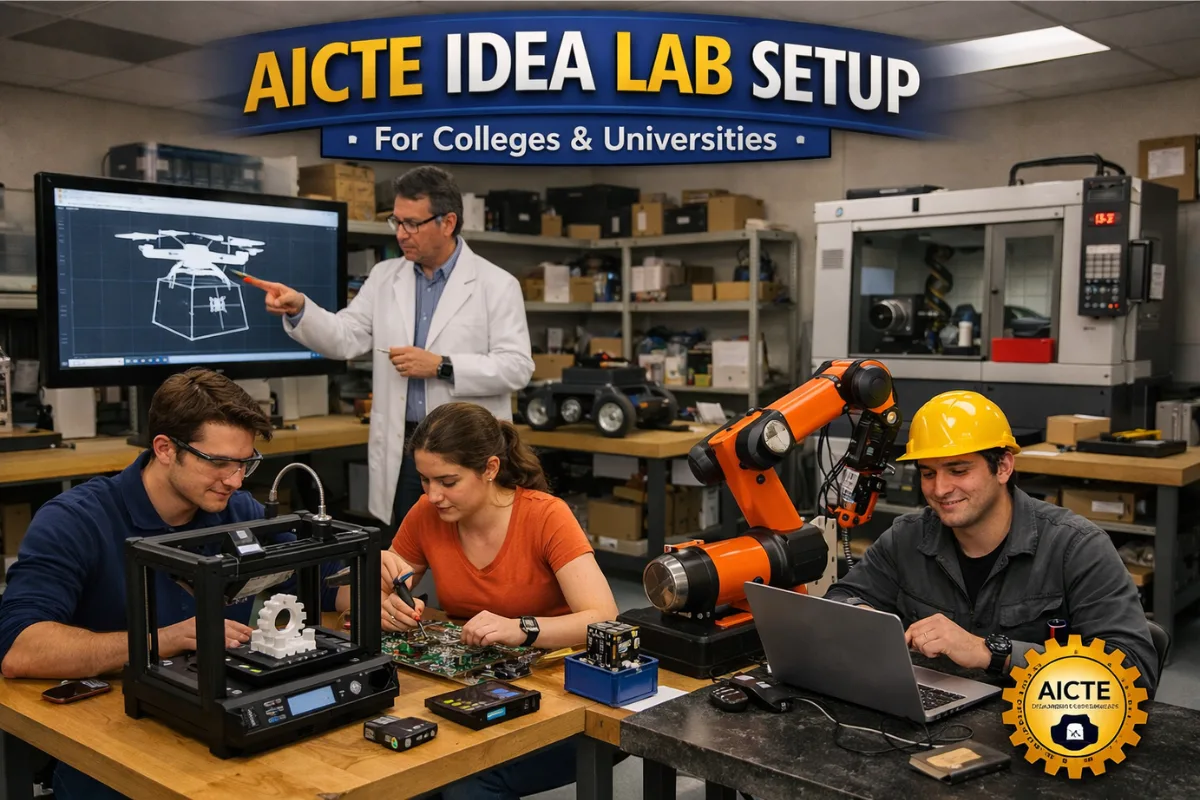
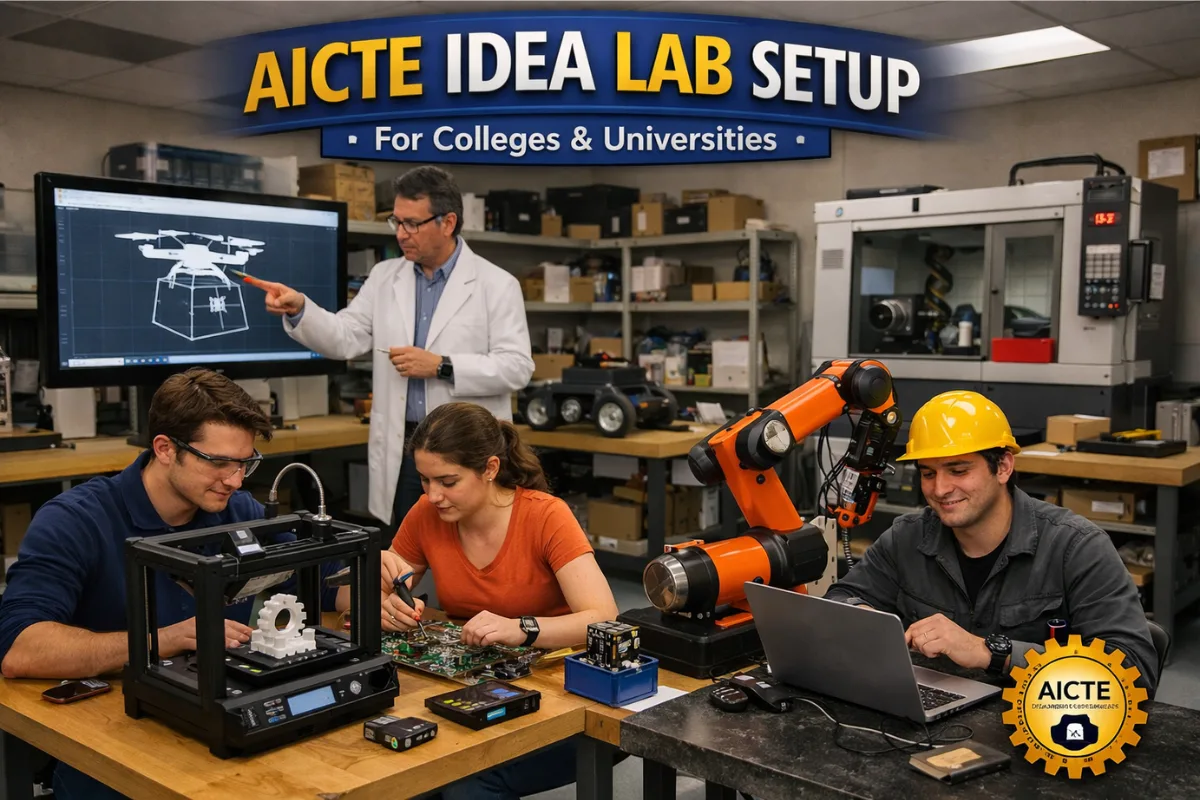
The All India Council for Technical Education (AICTE) IDEA Lab is a centralized innovation space that helps colleges turn student and faculty ideas into working prototypes through hands-on STEM learning. It provides engineering institutions with a practical setting where design thinking, problem-solving, and teamwork can move beyond theory into real-world project work.
If you are trying to understand how to set up an AICTE IDEA Lab at a college, this guide clearly covers the basics, including eligibility, space and equipment needs, expected costs, and the role these labs play in helping universities build a stronger culture of making, testing, and innovation.
Table Of Contents:
- What Is an AICTE IDEA Lab?
- How To Setup AICTE IDEA Lab In College: Start With Eligibility
- Step-by-Step Process To Set Up An AICTE IDEA Lab
- Who Manages The Lab After Setup?
- What To Avoid During Lab Planning
- Frequently Asked Questions
What Is An AICTE IDEA Lab?
An AICTE IDEA Lab is a centralized facility where students and faculty can build, test, and refine ideas through hands-on work. It gives colleges a dedicated space for skill-based learning, prototype development, and collaborative project work.
Here’s what the facility offers:
- Turns ideas into prototypes: Helps students move from concept to working model.
- Supports hands-on learning: Brings practical work into the learning process.
- Encourages teamwork: Brings students from different departments together on projects.
- Builds problem-solving skills: By creating space to test, improve, and refine ideas.
- Supports entrepreneurship: Helps students develop projects with practical value.
Do You Know The Difference?
🔹 AICTE IDEA Lab: Designed for idea development, practical application, and collaboration across departments.
🔹 Regular Lab: Usually focused on subject-specific experiments linked to the syllabus.
How To Setup AICTE IDEA Lab In College: Start With Eligibility
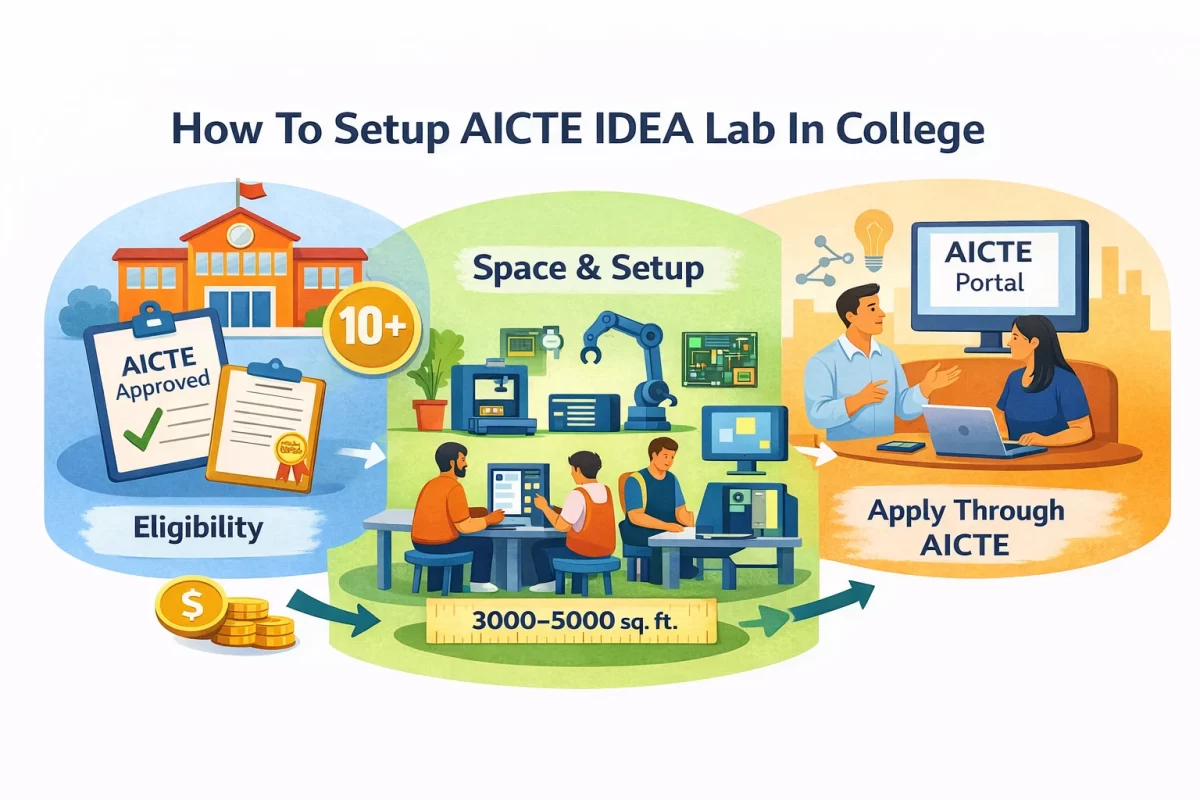
Before planning an innovation lab for universities, it is important to check whether the college qualifies for the scheme and can support the lab effectively.
Start With Eligibility
- The institution should be an AICTE-approved engineering college or university department.
- It should have been operational for at least 10 years.
- At least one course must have live NBA accreditation.
Plan The Required Space And Setup
- A minimum of 3,000 sq. ft. of built-up, furnished area is required.
- Around 5,000 sq. ft. is considered a stronger setup.
- The layout should cover both the working lab area and a student activity space.
What Should The AICTE Idea Lab Equipment List Include?
- Fabrication tools: 3D printer, laser cutter, CNC router, vinyl cutter, and 3D scanner.
- Electronics setup: Soldering stations, oscilloscopes, signal generators, power supplies, and computer workstations.
- Workshop tools: Drilling tools, hand tools, and basic project accessories.
- Consumables: Filaments, acrylic sheets, adhesives, and other regularly used materials.
- Safety essentials: Fire extinguisher, first aid box, and safety signage.
How Much Does It Cost?
- AICTE scheme estimates the project cost at ₹90 lakh.
- AICTE support is available up to ₹30 lakh.
- The institution should be ready to contribute at least 50% of the total project cost.
Apply Through The AICTE Portal
Once the basics are ready, the institution can submit its proposal. Selection depends on preparedness, clarity of purpose, and the ability to create a strong, conducive learning environment.
Step-by-Step Process To Set Up An AICTE IDEA Lab
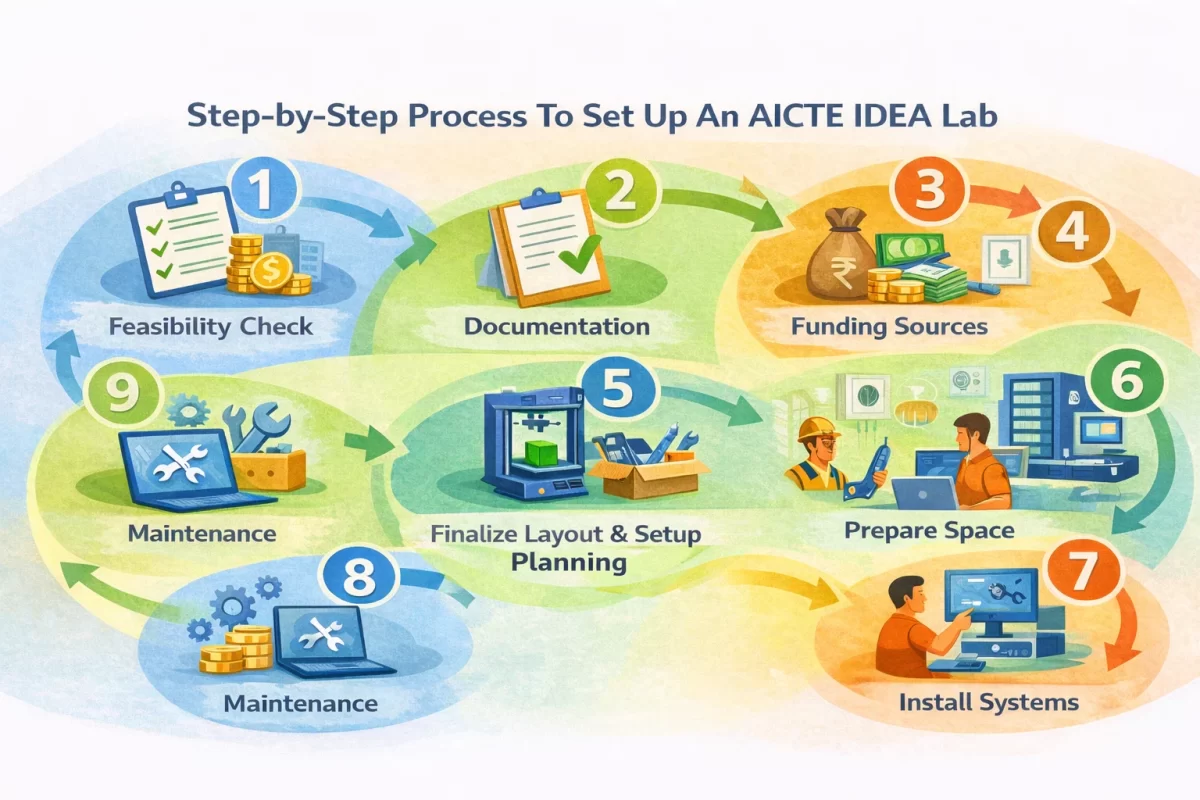
- Step 1: Start with a feasibility check: Map what the institution can realistically support. Look at available space, budget range, and how the lab fits into your academic priorities.
- Step 2: Prepare AICTE documentation: Assemble the required documents for approval. This includes lab intent, internal approvals, faculty roles, and a clear outline of the facility’s use.
- Step 3: Identify funding sources. Plan where the investment will come from. This could include AICTE schemes, government programs like RUSA or PM-USHA, or internal institutional budgets.
- Step 4: Finalize layout and setup planning: Define zones, power requirements, furniture placement, and network setup so everything works smoothly once installed.
- Step 5: Procure equipment and resources: Select and source the required machines, tools, and software. Ensure everything meets the required standards and aligns with the lab’s purpose.
- Step 6: Prepare the physical space: Ensure proper electrical work, lighting, ventilation, internet connectivity, and safety provisions are in place before installation begins.
- Step 7: Install and configure systems: Set up all equipment, install required software, and ensure everything is working as expected for daily use.
- Step 8: Train faculty and onboard students: Equip faculty with the knowledge to manage the lab and guide projects. Introduce students to the facility through orientation and initial activities.
- Step 9: Plan ongoing maintenance and support: Keep the lab functional with regular upkeep, software updates, and structured support to ensure consistent usage over time.
💯 Pro Tip: Plan a simple booking and usage system from day one. Even a well-equipped lab can become difficult to manage if access, project time, and equipment use are not organized properly. A basic schedule helps avoid clashes, keeps the space active, and makes the lab easier for both students and faculty to use consistently.
See how CO2 lasers support AICTE IDEA Labs in practical settings. Read: How Are AICTE’s IDEA Labs Democratizing Advanced Prototyping With CO2 Lasers?
Who Manages The Lab After Setup?
An AICTE IDEA Lab is managed by the host institution after setup, with the college or university taking charge of its day-to-day operations and long-term maintenance.
- Faculty-driven guidance: Dedicated faculty members oversee the lab and help students make the most of the facility through practical involvement and project support.
- Core management team: A coordinator, co-coordinator, and support staff typically handle administration, scheduling, and smooth everyday functioning.
- Industry linkage: Institutions are also expected to build connections with industry, so student work stays practical, relevant, and better aligned with real requirements.
What To Avoid During Lab Planning
A few early mistakes can weaken the AICTE IDEA lab’s purpose, even when the setup looks complete on paper.
- ⚙️ Starting with machines instead of goals: Buying equipment first can lead to a setup that looks impressive but does not match the requirements.
- 📦 Overlooking day-to-day requirements: Space, support staff, and regular-use materials are just as important as the main equipment.
- 🖼️ Treating the lab like a showcase area: The lab should stay active with real student work, not sit as a facility that is only shown during visits or events.
- 🎓 Skipping training and activity planning: Without faculty guidance, student onboarding, and regular project activity, the lab can remain underused.
- 🔄 Ignoring long-term upkeep: A lab needs ongoing attention to stay functional, organized, and useful over time.
✍️ Why Many IDEA Labs Choose Prakash Laser CO2 Machines?
With over 20 years of experience in laser technology, Prakash Laser understands the operational needs of educational institutions and research facilities across India. Our CO2 laser machines support practical lab activities and project development, making them a strong fit for AICTE IDEA Labs.
Frequently Asked Questions
1. Can private colleges set up an AICTE Idea Lab?
Yes, private colleges can apply, provided they meet the scheme requirements, such as AICTE approval, age of institution, accreditation, and infrastructure readiness.
2. What is the difference between a makerspace and an Idea Lab?
A makerspace is a broader creative workspace for building and experimenting. At the same time, an AICTE IDEA Lab is a scheme-based institutional setup with defined eligibility criteria, equipment, funding structure, and academic purpose. The Idea Lab is more formal and policy-linked.
3. What are the benefits of an Idea Lab for students?
It gives students a place to develop ideas into workable outcomes, build practical skills, work across departments, and gain stronger exposure to design, testing, and project execution.
4. How can colleges apply for AICTE IDEA Lab funding?
Eligible colleges need to submit a proposal through the AICTE application process when the scheme window opens. The proposal is reviewed based on preparedness, infrastructure, vision, and the lab’s ability to support student learning and project work.
5. Is an AICTE IDEA Lab only for engineering colleges?
The scheme is mainly meant for AICTE-approved engineering colleges and university departments that meet the stated eligibility requirements.
6. Can an AICTE IDEA Lab be used by multiple departments?
Yes, it is meant to support multidisciplinary learning, so students and faculty from different departments can use the same facility.
7. Does AICTE fully fund the IDEA Lab setup?
No, AICTE support is partial. The institution is also expected to contribute a significant share of the total project cost.
Read More Articles:
- CO2 Laser Cutting Machine With Pass-Through Door Design
- CO2 Laser vs Diode Laser: What Is The Difference?
- How To Extend The Life Of Your CO2 Laser Tube: Tips For Longevity