

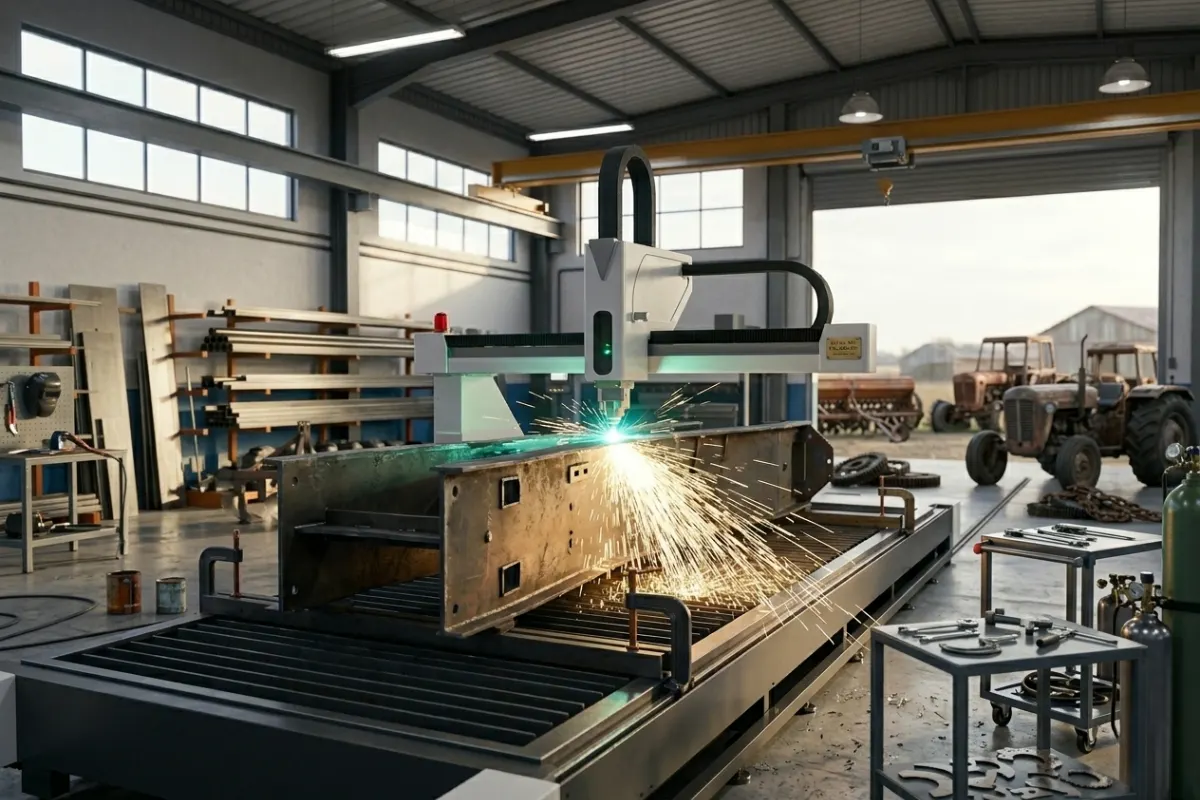
Agricultural equipment production is evolving beyond standard designs and predictable workflows. Today’s farm equipment manufacturing involves more complex assemblies, tighter tolerances, and a wider mix of components across tractors, harvesters, and field systems. This shift is pushing fabrication processes to deliver consistent output without slowing down downstream operations.
A Fiber Laser Cutting Machine for agriculture equipment is increasingly being considered in this space because it allows manufacturers to handle detailed metal components with better accuracy and repeatability. Whether used in agricultural machinery fabrication or high-volume part production, the process supports cleaner cuts and more stable batch output.
This article breaks down how a laser cutting machine for agricultural machinery fits into real production environments, along with its applications, benefits, and key considerations before investment.
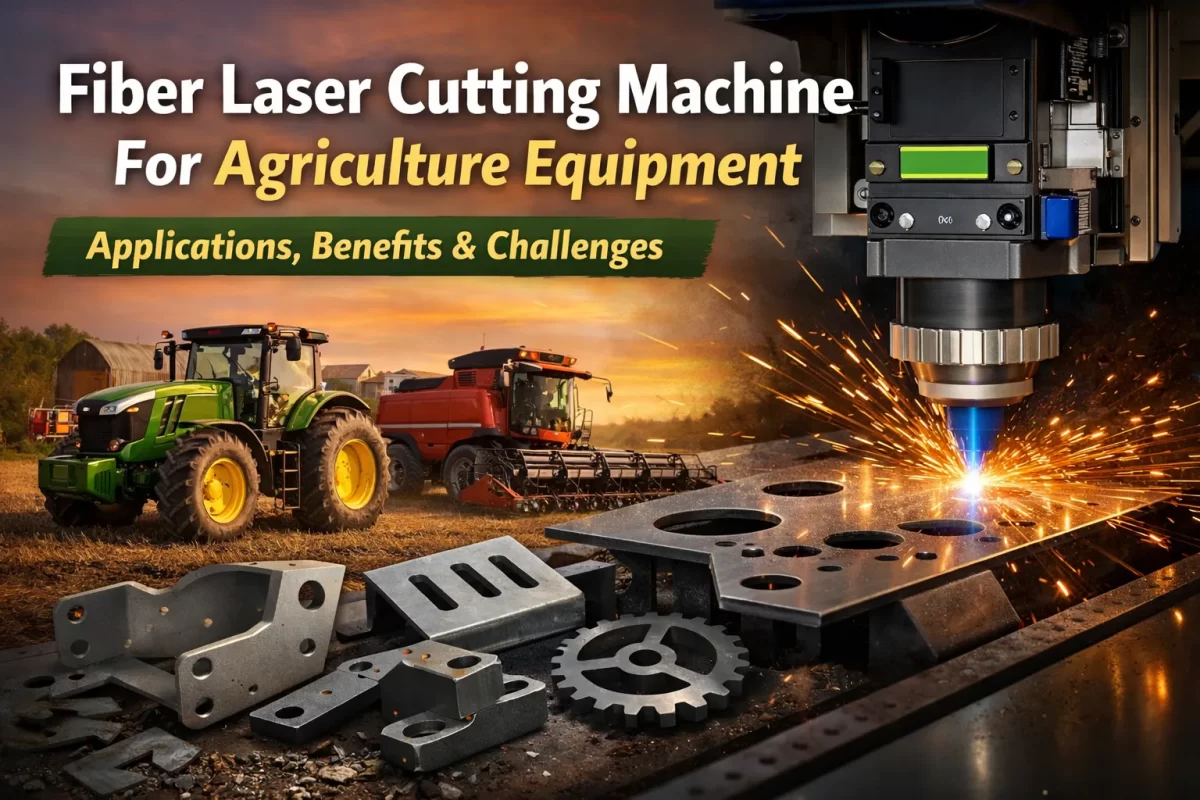
Agricultural Parts Made With Fiber Laser Cutting Machine
A Fiber Laser Cutting Machine for agricultural parts supports the production of a wide range of components used across modern equipment. Its role becomes clearer when tied directly to real fabrication requirements.
Tractor and load-bearing components
In tractor component manufacturing, parts like chassis plates, mounting brackets, axle supports, and hitch plates must align correctly during welding and assembly. These components often include multiple hole patterns and joining edges, where consistent cut geometry plays an important role in reducing fit-up errors.
Harvester and implement structures
Harvesters and field implements rely on side panels, reinforcement sections, and protective housings. A metal-cutting machine for farm equipment manufacturing helps maintain uniform edge profiles and cutouts across batches, which is important for both assembly and replacement-part compatibility.
Tubular frames and structural assemblies
Frames and support systems often use round and square tubes. Laser-cut slots and joints improve alignment during fabrication, making it easier to assemble structural components without excessive manual correction.
Irrigation and planting system components
Smaller parts of the solar irrigation pumping system like clamps, metering plates, and pipe supports require tighter tolerances. In these cases, precision cutting for agricultural equipment becomes important because variation can affect installation and field performance.
Benefits Of Fiber Laser Cutting Machines For Agricultural Parts
A Fiber Laser Cutting Machine for agricultural parts improves fabrication performance in areas that directly impact assembly, finishing, and overall workflow.
Improved assembly accuracy
Better dimensional control helps components align more effectively during welding, especially in structural assemblies used in agricultural machinery fabrication.
Reduced finishing workload
Cleaner edges reduce the need for grinding and secondary processing, allowing parts to move faster through production stages in metal fabrication for agriculture industry setups.
Faster handling of mixed production
Switching between part designs is easier without dedicated tooling, making it suitable for manufacturers handling both repeat batches and custom jobs.
Better material utilization
Efficient nesting improves sheet usage, which is important in large-scale farm equipment manufacturing where material cost plays a significant role.
Consistency in replacement parts
Uniform output ensures that replacement components fit properly into existing assemblies, which is critical for field equipment reliability.
The process is also being adopted across other sectors. For more information, refer to our blog on the “Top Industries Using Fiber Laser Cutting Machines.”
Choosing The Right Fiber Laser Cutting Machine For Agriculture Equipment
Choosing the right laser cutting machine for agricultural machinery depends on what parts are produced most often, how thick the material runs tend to be, and how the cutting stage fits into the wider fabrication process. The decision usually becomes easier when manufacturers compare machine type, power range, output requirements, and workflow needs against actual production conditions.
Sheet laser, tube laser, or sheet-and-tube combo?
- A sheet laser is the better fit when production mainly includes flat parts such as brackets, covers, plates, and support panels.
- A tube laser is better suited for workloads involving frames, boom sections, structural members, and round or square tubing.
- A sheet-and-tube combo makes more sense when both flat parts and tubular components are part of regular production.
Power level and thickness range
- Machine power should match the thickness range processed most often, not just occasional heavy jobs.
- Higher power can improve cutting speed on thicker materials, but it also increases machine cost and operating requirements.
- The better choice usually comes from comparing everyday workload demands with expected production output.
Precision, edge quality, and weld preparation
- Cut quality matters when parts move directly into bending, fitting, or welding.
- Better slot accuracy, cleaner profiles, and improved edge condition can reduce the amount of correction work before assembly.
- This becomes more important in agricultural machinery production, where repeated parts must stay consistent across batches.
Manufacturers comparing power range can also review our guide on “1.5kW vs 2kW vs 3kW Fiber Laser Cutting Machine” before matching machine output with material thickness and daily workload.
Automation, software, and nesting
- Automation features are more useful when production volume is high or when part flow needs to move faster between jobs.
- Software should make programming, job setup, and production handling easier for operators.
- Strong nesting capability is important when sheet usage and material costs are part of the machine selection decision.
Workflow and fabrication-line fit
- Machine selection should also reflect how the cutting stage connects with loading, unloading, welding, and later assembly steps.
- A machine that cuts well but slows material flow or increases handling time may not integrate effectively with the production line.
- This is why machine choice should be reviewed as part of the full fabrication workflow, not as a stand-alone cutting decision.
The right choice usually comes from matching machine configuration to regular part mix, material range, and production flow rather than choosing only by maximum capacity or headline specifications.
Fiber Laser vs Traditional Metal Cutting For Agriculture Equipments
In farm equipment manufacturing, the choice between fiber laser and traditional methods often depends on how much value is placed on precision versus cutting cost. A laser cutting machine for agricultural machinery becomes more effective when the finishing time is reduced, and better part accuracy improves downstream efficiency.
Fiber laser vs plasma cutting
Fiber laser and plasma cutting are both used in metal fabrication for agriculture industry setups, but they differ in how they handle precision, edge condition, and material range.
| Factor | Fiber Laser Cutting | Plasma Cutting |
| Cut precision | Usually better for tighter cuts, smaller holes, narrow slots, and more detailed agricultural parts. | Better suited to jobs where fine detail is less important, and the cut profile is simpler. |
| Edge quality | Often produces cleaner edges, which can reduce finishing time before welding or assembly. | More likely to leave rougher edges, increasing grinding or cleanup time. |
| Heat impact | Creates a narrower heat-affected area on many parts, which helps when nearby features must remain stable. | Produces a wider heat-affected zone, which can more noticeably affect the edge condition and nearby material. |
| Thin to medium metals | Performs more effectively on thin- to medium-thickness metals used in many agricultural components. | Can process this range, but cut finish and detail quality may be less refined. |
| Part complexity | Better for curves, slots, holes, and detailed profiles requiring tighter dimensional control. | Better suited to simpler shapes and heavier cutting tasks. |
| Post-cut work | In many jobs, it can shorten secondary finishing effort and move parts faster into the next fabrication stage. | In many cases, it requires more post-cut cleanup before parts are ready for welding or assembly. |
| Production flow | Often, a stronger fit, with part quality and reduced finishing, supports smoother downstream fabrication. | Often, a better fit is where heavier sections and simpler cuts matter more than finish quality. |
Fiber laser vs mechanical cutting and stamping
Mechanical cutting and stamping are widely used in farm equipment manufacturing, especially for high-volume production. However, they differ significantly from fiber laser systems in terms of flexibility and setup.
| Factor | Fiber Laser Cutting | Mechanical Cutting and Stamping |
| Tooling needs | Does not require fixed dies for every design change. | Often depends on dedicated tools or dies for each part shape. |
| Design flexibility | Makes it easier to cut revised shapes, custom parts, and short-run jobs. | Less flexible when part designs change frequently. |
| Setup time | Allows faster changeovers between different production jobs. | Tool changes and setup adjustments can take more time. |
| Complex shapes | Cuts detailed profiles and internal features more easily. | May be less practical for intricate shapes or varied cut patterns. |
| Best production fit | Works well for mixed batches, custom work, and medium-volume agricultural parts. | Often suits high-volume production of the same part design. |
| Upfront preparation | Needs programming and machine setup, but no custom hard tooling. | May require extra preparation for tooling before production starts. |
Even if a fiber laser performs well on paper, the investment still needs to be tested against ownership costs and production realities.
Challenges & Considerations Before Investing In A Fiber Laser Cutting Machine
Investing in a Fiber Laser Cutting Machine for agricultural equipment also requires careful evaluation of operational factors beyond cutting performance.
- Skilled handling still plays a role in maintaining consistent output
- Downtime can affect multiple stages of agricultural machinery fabrication if cutting is a central process
- Operating costs, such as gas and power usage, can vary depending on workload
These factors should be reviewed alongside production needs in metal fabrication for agriculture industry environments.
For cost planning, it is useful to review the price of Fiber Laser Cutting Machines in India before comparing long-term operating expenses and machine fit.
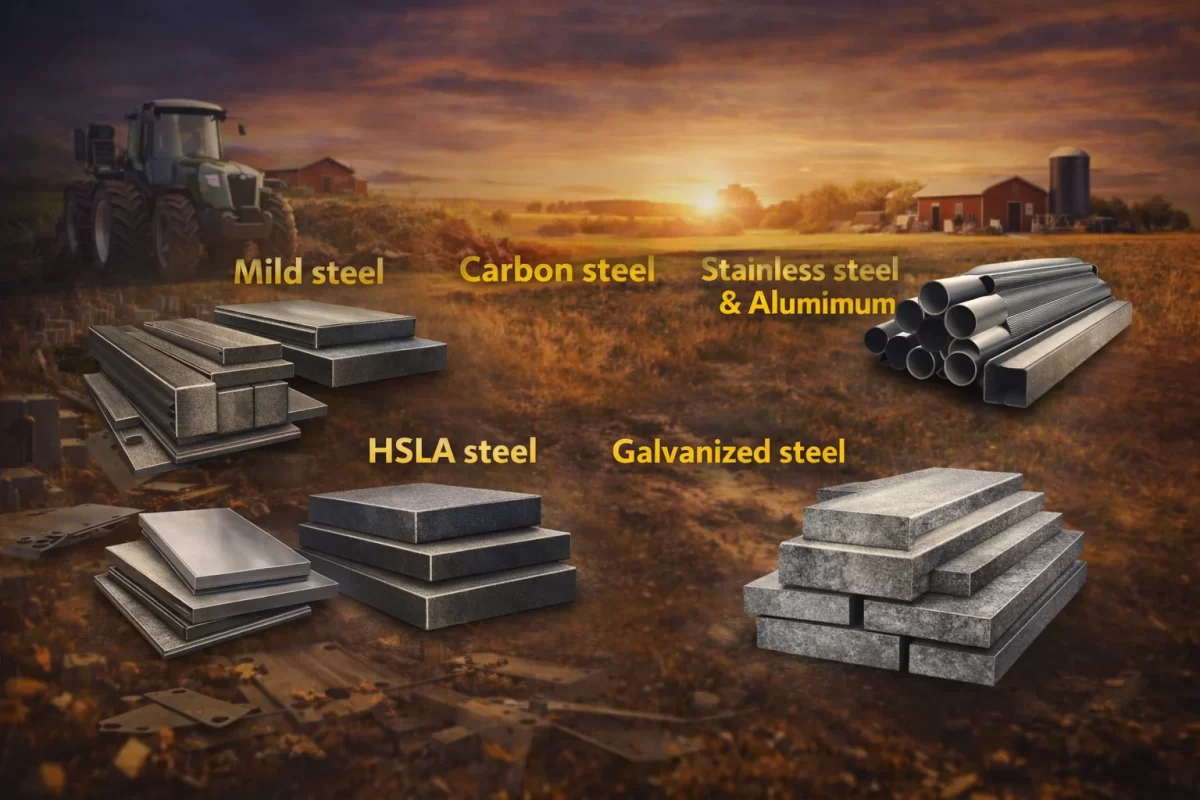
Materials Used In Metal Fabrication For The Agriculture Industry
Material selection in agricultural fabrication is closely tied to how each component performs in real working conditions.
- Mild steel and carbon steel → Common in frames, brackets, and general structural parts due to their strength and ease of processing
- HSLA steel → Used where weight reduction is needed without compromising strength, such as in larger structural assemblies
- Stainless steel → Preferred for components exposed to moisture, fertilizers, or chemicals
- Aluminum → Applied in parts where reducing overall equipment weight improves handling or transport
- Galvanized steel → Widely used in outdoor structures and support systems that require corrosion protection
Each of these materials responds differently to laser cutting, so process settings must be adjusted based on thickness, coating, and thermal behavior.
For more details on material behavior and process considerations, our “Stainless Steel Laser-Cutting Process Guide” is worth your time.
Moreover, you can see some practical metal cutting samples here.
Is Fiber Laser Cutting The Right Investment?
A Fiber Laser Cutting system becomes a stronger investment when it reduces dependency on external vendors and shortens the time between design and production.
It is often a stronger fit for:
- Manufacturers produce a wide range of agricultural parts
- Operations handling both repeat jobs and revised designs
- Facilities that want to reduce finishing time before bending or welding
It may require more careful evaluation when:
- Production volume is low, and outsourcing still makes financial sense
- Very thick material dominates the workload
- Floor space or support infrastructure is limited
- The team is not ready for training, maintenance, or software integration
Wrapping Up
In agricultural equipment manufacturing, where part variety and production pressure continue to increase, fabrication processes must support both precision and flexibility. Fiber Laser Cutting fits well into this shift by helping manufacturers maintain consistent output while adapting to changing design and production requirements.
As fabrication setups move toward more integrated and automated workflows, its role is likely to become more central in handling structural components, replacement parts, and evolving machinery designs.
Frequently Asked Questions
1. What is a Fiber Laser Cutting Machine for agriculture equipment?
A Fiber Laser Cutting Machine For Agriculture Equipment is used to cut metal parts required in agricultural equipment manufacturing. It helps produce shapes for frames, brackets, panels, tubes, and other machine components with greater consistency.
2. What agricultural parts can be made with a Fiber Laser Cutting Machine?
It can cut tractor parts, harvester components, tiller sections, brackets, mounting plates, tubes, and structural assemblies. It is also useful for smaller parts used in irrigation and planting systems.
3. Is Fiber Laser Cutting better than plasma cutting for farm equipment manufacturing?
Fiber Laser Cutting usually provides cleaner edges and better dimensional control on many agricultural parts. Plasma cutting may still be used for heavier jobs where fine detail is less important.
4. Can one machine cut both sheet metal and tubes?
Yes, some machines are designed to process both flat sheets and tubular materials. These systems are useful for manufacturers that produce mixed agricultural parts in a single facility.
5. Which metals are commonly used in agricultural machinery fabrication?
Common materials include mild steel, carbon steel, HSLA steel, stainless steel, aluminum, and galvanized steel. Each material is selected based on strength, weight, corrosion resistance, and part function.
6. How do I choose the right laser cutting machine for agricultural machinery?
The right laser cutting machine for agricultural machinery depends on part type, material thickness, production volume, and workflow needs. Buyers should also compare machine configuration, cut quality, software, and operating costs.
7. What are the main benefits of a Fiber Laser Cutting Machine for agricultural parts?
A Fiber Laser Cutting Machine for agricultural parts helps manufacturers cut components more accurately, reduce finishing time, improve material use, and keep repeated production more stable. These advantages are especially useful when part fit and workflow speed matter.
8. What should buyers consider before investing in this machine?
Buyers should compare machine type, training needs, maintenance demands, gas use, floor space, and after-sales support. The machine should fit regular production needs rather than occasional peak demand.
9. What thickness range is typically suitable for Fiber Laser Cutting in agricultural fabrication?
Fiber laser systems are commonly used for thin to medium-thickness metals. The exact range depends on machine power, but most agricultural components fall within a range where both cut quality and speed can be maintained efficiently.
10. Does laser cutting affect weld quality in agricultural parts?
When properly configured, laser cutting can support better weld preparation by producing cleaner edges and more consistent joint geometry, which helps improve overall weld consistency.