

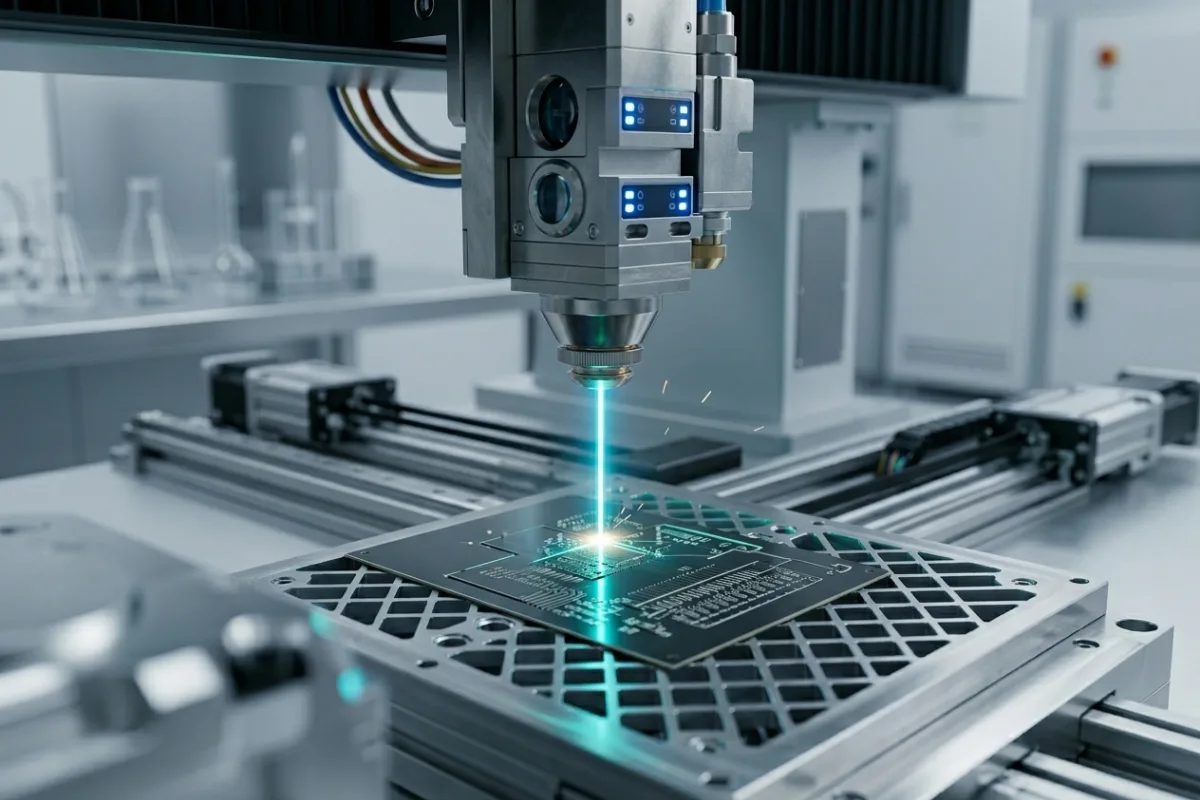
Electronics manufacturing now demands cutting methods that can keep pace with smaller components, tighter layouts, and repeated production runs. Fiber Laser cutting has become a practical option in this space because it enables precise shaping, cleaner cut edges, and more consistent results for detail-sensitive parts.
This becomes more important as miniaturization increases the difficulty of maintaining cut quality in thin and compact structures. In such conditions, micron-level precision and process control can affect how well parts move into inspection, placement, or final assembly. That is why Fiber Laser cutting is gaining attention in electronics production, where stable output and controlled material processing are required.
Table of Contents
- How Does Fiber Laser Cutting Work In Electronics Manufacturing?
- Operational Benefits Of Fiber Laser Cutting in Electronics Manufacturing
- Key Applications Of Fiber Laser Cutting For Electronic Components
- Materials Commonly Processed Through Laser Cutting In Electronics
- Limitations of Fiber Laser Cutting in Electronics
- Laser Type For Electronics Manufacturing: Fiber, UV, CO2, and Ultrafast
- How to Decide if Fiber Laser Cutting Is Right for Your Production Line
- Wrapping Up
- FAQs
How Does Fiber Laser Cutting Work In Electronics Manufacturing?
Fiber Laser cutting in electronics manufacturing starts with a digital design file that defines the shape, cut path, and fine features required for each part. That file is used to guide the laser with controlled movement, which is important when working with small components, narrow geometries, and repeated production runs.
The cutting process uses a laser beam generated in the source and delivered through an optical fiber to the cutting head. The beam is then focused into a very small point on the material surface, allowing the system to create narrow cut lines and detailed features with close dimensional control.
Because the process is CNC-guided, the laser follows the programmed path with consistent positioning from one part to the next. This helps maintain repeatable results in electronics manufacturing, where small dimensional shifts can affect fit, alignment, and later assembly steps.
Operational Benefits Of Fiber Laser Cutting For Electronics
Fiber Laser cutting offers several practical benefits in electronics manufacturing. It can improve dimensional accuracy, reduce physical stress on delicate materials, create cleaner edges, support faster processing, and lower maintenance needs.
These advantages have a direct effect on electronics production, where small parts and repeated runs require uniform results. In practical terms, performance is often judged through metrics such as cut accuracy, feature repeatability, processing speed, and the amount of post-processing required before assembly.
- Tighter tolerances for compact electronics: Helps maintain close dimensional control in parts with fine patterns and narrow spacing. This improves fit during assembly and reduces variation between pieces.
- Lower mechanical stress on fragile components: Cuts without direct contact with the material. This reduces the risk of cracking, bending, or shifting in thin, delicate structures.
- Cleaner edges with less post-processing: Produces smoother cut edges on many electronics materials. This reduces the amount of finishing work before inspection or assembly.
- Higher throughput for prototyping and production: Processes programmed designs quickly once setup is complete.
- Reduced tool wear and maintenance: Does not rely on blades or cutting tools that wear down during use. This lowers interruptions caused by tool replacement or adjustment.
These operational benefits become more relevant when viewed through the lens of the actual component-level tasks in which the Fiber Laser Cutting Machine is used. In electronics manufacturing, the process is applied in several areas where cut accuracy, edge quality, and repeatability directly affect downstream work.
Key Applications Of Fiber Laser Cutting For Electronic Components
Fiber Laser cutting improves several electronics manufacturing processes where cut accuracy, edge quality, and repeatability directly influence component preparation and downstream assembly. This becomes more relevant in products such as compact control boards, sensors, wearable electronics, and space-limited assemblies, where small feature sizes leave little room for cutting variation.
PCB shaping and feature cutting
Fiber Laser cutting is used to form PCB outlines, slots, and other board features requiring tight dimensional control. More uniform board geometry can improve placement accuracy during later assembly. Practically, this means fewer dimensional shifts between boards and more predictable handling during assembly.
PCB depaneling and board separation
The process is also used to separate individual boards from larger production panels with cleaner edge definition. This can reduce edge damage before inspection or assembly.
Thin metal parts and shielding elements
Fiber Laser cutting is used for thin metal parts such as housings, covers, and shielding elements. It supports cleaner edges and better dimensional fit in compact internal assemblies.
Connector and lead frame processing
The technology is also used for fine conductive parts, such as connectors and lead frames that require narrow patterns. Predictable geometry across repeated runs can improve fit in connection-related components.
Micro-feature cutting for compact electronics
Fiber Laser cutting is also used for very small cut features in compact electronic products. This is relevant in dense layouts where tighter cutting control affects final part quality.
Manufacturers considering wider industrial use can also review our blog, “The Industries That Employ Fiber Laser Cutting Machines,” which covers multiple production sectors.
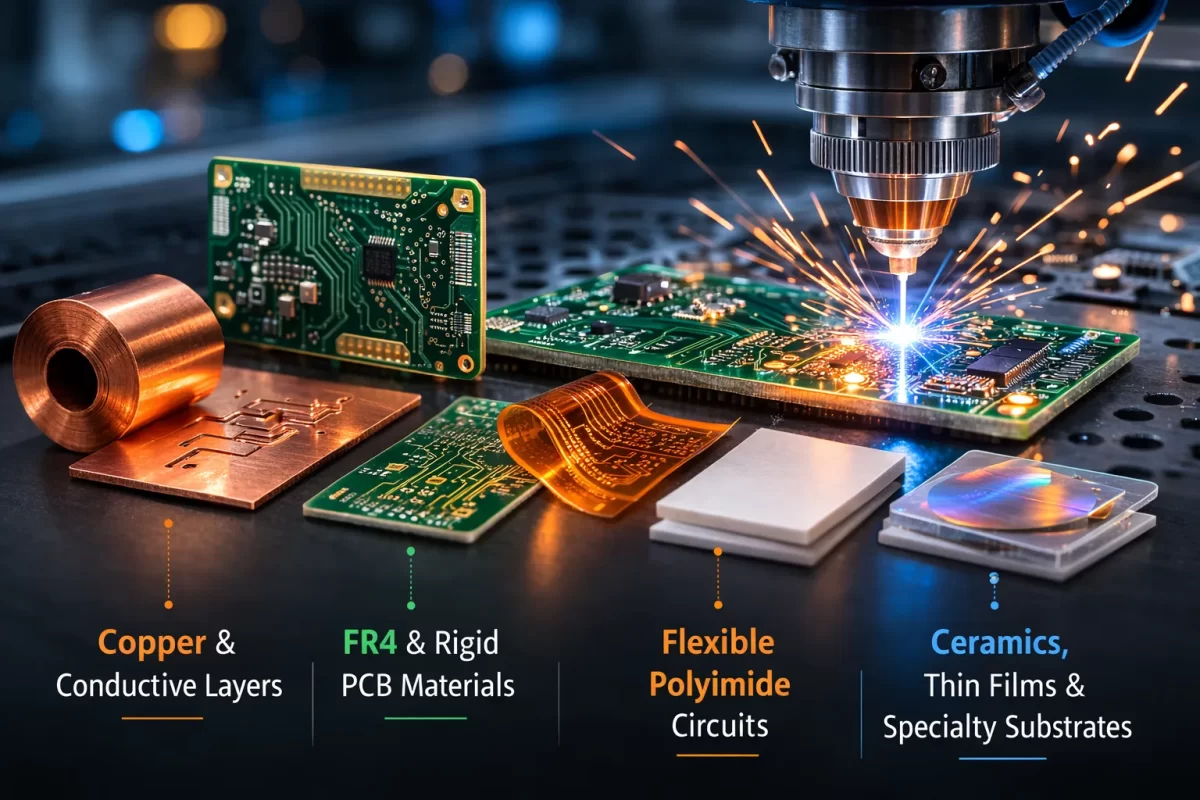
Materials Commonly Used In Electronics Laser Cutting
Material choice plays a major role in laser cutting of electronics because each substrate responds differently to laser energy. That is why cutting parameters often need to be adjusted based on the material being processed and the desired result. Material response becomes more important in compact or multi-layer electronics where fine features and tighter tolerances reduce the margin for cutting variation.
Copper and other conductive layers
- Copper and similar conductive layers are commonly used in circuit traces and other pathways within electronic assemblies.
- Laser cutting can help shape thin conductive sections used in detailed board layouts.
FR4 and rigid PCB substrates
- FR4 is one of the most widely used materials in printed circuit board manufacturing.
- Laser cutting is often used to define board outlines and internal cut features.
- Suitable for rigid PCBs used in many electronic products.
Flexible polyimide materials
- Polyimide is widely used in flexible circuits that need to bend without losing structural function.
- Laser cutting maintains the form of detailed layouts while reducing stress on the material.
- Works well in electronics designs that require thin, flexible structures.
Ceramics, thin films, and specialty materials
- Some advanced electronic components rely on ceramic and thin-film materials for specialized applications.
- Fiber Laser cutting can form detailed shapes in these substrates with close control.
- Useful for parts that require defined patterns and stable structural performance.
Material compatibility is only one part of process selection. Manufacturers also need to consider where Fiber Laser cutting may require tighter control, higher investment, or a different laser type altogether.
These samples show how laser-cutting results can vary across different materials and electronic applications.
Limitations Of Fiber Laser Cutting In Electronics
Even when Fiber Laser cutting is suitable for the material and application, certain process limits must still be considered in electronics manufacturing. These usually relate to equipment cost, parameter sensitivity, substrate behavior, and heat control.
Initial equipment investment
- Fiber Laser systems typically require a higher initial investment compared with basic cutting equipment.
- Installation, integration, and training costs may also be involved.
Process tuning for sensitive materials
- Some electronic materials require careful adjustment of laser parameters.
- Power level, speed, and beam focus must be optimized for stable results.
Not every electronics substrate favors the same laser type
- Different materials respond differently to various laser technologies.
- Some substrates may perform better with UV or ultrafast laser systems.
Edge quality and thermal management considerations
- Heat generated during cutting may affect nearby material.
- Proper parameter control improves clean edges and stable results.
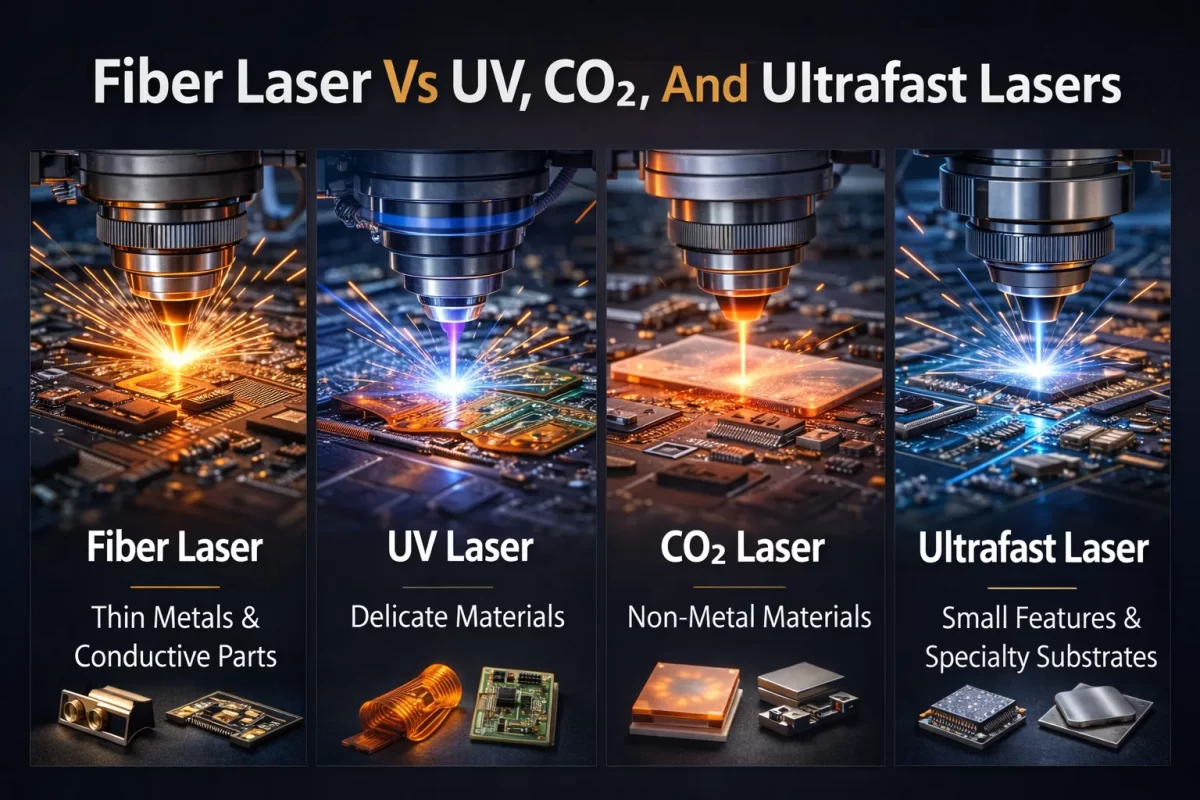
Laser Type For Electronics Manufacturing: Fiber, UV, CO2, and Ultrafast
Electronics manufacturing uses metals, polymers, films, and delicate substrates, so laser selection depends on heat control, precision, cost, and material type. For fine-feature electronics, process quality is often tied to how well the system maintains dimensional control across repeated parts and narrow cut geometries.
| Laser Type | Heat-Affected Zone | Precision Level | Relative Cost | Best-Fit Use Cases In Electronics |
| Fiber Metal Laser | Higher than UV and ultrafast, but manageable for thin metals with proper settings | Lowest among these options | Lower than ultrafast and often more cost-efficient for metal processing | Metal shields, connectors, lead frames, battery tabs |
| UV Laser | Lower than fiber and CO2, better for heat-sensitive materials | Very high for fine features | Higher than fiber in many electronics applications | Flexible circuits, PCB features, thin films, coated materials |
| CO2 Laser | Lower than fiber and CO2, better for heat-sensitive materials | Moderate | Often suitable for selected non-metal work | Plastics, polymers, insulating materials, labels |
| Ultrafast Laser | Lowest among these options | Extremely high; suited for micro-scale and highly specialized fabrication | Highest due to system complexity | Microelectronics, glass, ceramics, precision fabrication |
For manufacturers evaluating cost and application fit, check out our article, “The Price Of Fiber Laser Cutting Machines In India,” and align machine selection with budget planning.
Choosing Fiber Laser Cutting For Your Production Line
Not every electronics manufacturing setup has identical cutting requirements. Choosing the right method involves evaluating production conditions and component characteristics.
- Review the size and complexity of components processed in your production line.
- Confirm that the materials being used are compatible with Fiber Metal cutting.
- Consider the level of dimensional accuracy required during assembly.
- Evaluate whether your production involves prototypes, repeated batches, or large-scale output.
- Check how easily the system integrates with existing automation or digital manufacturing setups.
- Compare long-term production value with initial investment and setup costs.
In addition to evaluating in-house capabilities, manufacturers may also consider outsourcing to specialized providers. For example, our blog on “Fiber Metal Laser Cutting Service in Delhi NCR by Prakash Laser” showcases how an experienced service provider meets precision metal-cutting requirements with consistent results, controlled processing, and scalable production capabilities.
Wrapping Up
Fiber Laser cutting for electronics is becoming increasingly relevant in the manufacturing sector, where controlled processing, stable output, and repeatable results contribute to product quality. Its value becomes especially clear in production environments that handle compact designs, detailed structures, and advanced electronic materials. Evaluating your materials, component designs, and production requirements early can help identify the most practical solution for long-term manufacturing efficiency.
Frequently Asked Questions
1. How is laser cutting used in electronics manufacturing?
Laser cutting shapes circuit boards, conductive parts, and thin metal elements used in electronic assemblies. It allows manufacturers to process intricate designs during different stages of electronics production.
2. What industries use laser cutting for electronics?
Industries such as consumer electronics, automotive electronics, telecommunications, medical device manufacturing, and aerospace systems frequently rely on laser cutting technologies.
3. What assist gases are used in Fiber Laser cutting machines?
Common assist gases include nitrogen, oxygen, and compressed air. The chosen gas depends on the material being processed and the cutting requirements.
4. What materials are commonly processed in electronics laser cutting?
Copper layers, FR4 boards, flexible polyimide circuits, ceramics, thin films, and other specialized substrates are commonly processed using laser cutting in electronics manufacturing.
5. Can Fiber Laser cutting handle very small electronic components?
Yes. Fiber Laser systems can process small electronic parts that require controlled cutting paths and stable shaping.
6. Are Fiber Lasers suitable for flexible circuit materials?
Fiber Lasers can process certain flexible materials, depending on the substrate type and cutting parameters.
7. How do manufacturers choose between fiber and UV lasers?
The decision typically depends on material sensitivity, feature size, and thermal tolerance requirements.
8. What general factors should be reviewed before starting laser cutting work?
Before starting laser cutting, it is important to review the material type, thickness, heat sensitivity, and required edge quality. Setup factors such as beam focus, speed, and power also need attention.
9. What factors affect cut quality in electronics and laser cutting for semiconductor manufacturing?
Material properties, laser settings, beam focus, and cutting speed all play a role in edge quality and overall consistency. In electronics applications and laser cutting for semiconductor manufacturing, careful control of parameters is especially important when working with very small features and sensitive materials.
10. Is Fiber Laser cutting better than plasma cutting?
Fiber Laser cutting is generally better for applications that require finer detail, cleaner edges, and closer dimensional control. Plasma cutting is more often used for thicker metal work, while Fiber Lasers are better suited to smaller and more detailed parts.
11. What materials can a Fiber Laser cutting machine cut?
A Fiber Laser cutting machine can cut materials such as thin metals, copper sections, conductive layers, and selected substrates used in electronics manufacturing. The exact range depends on the machine setup and the material requirements of the application.