

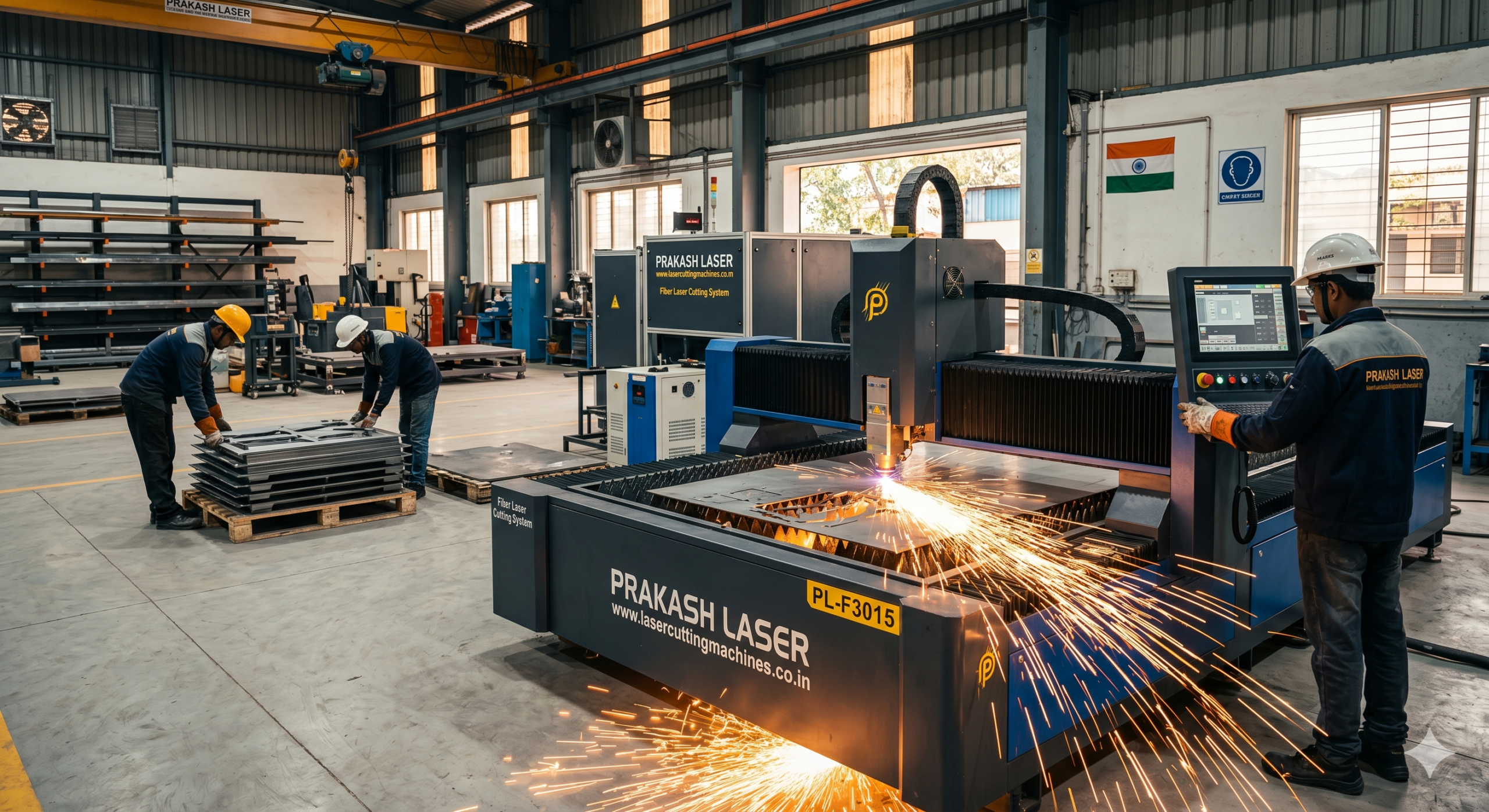
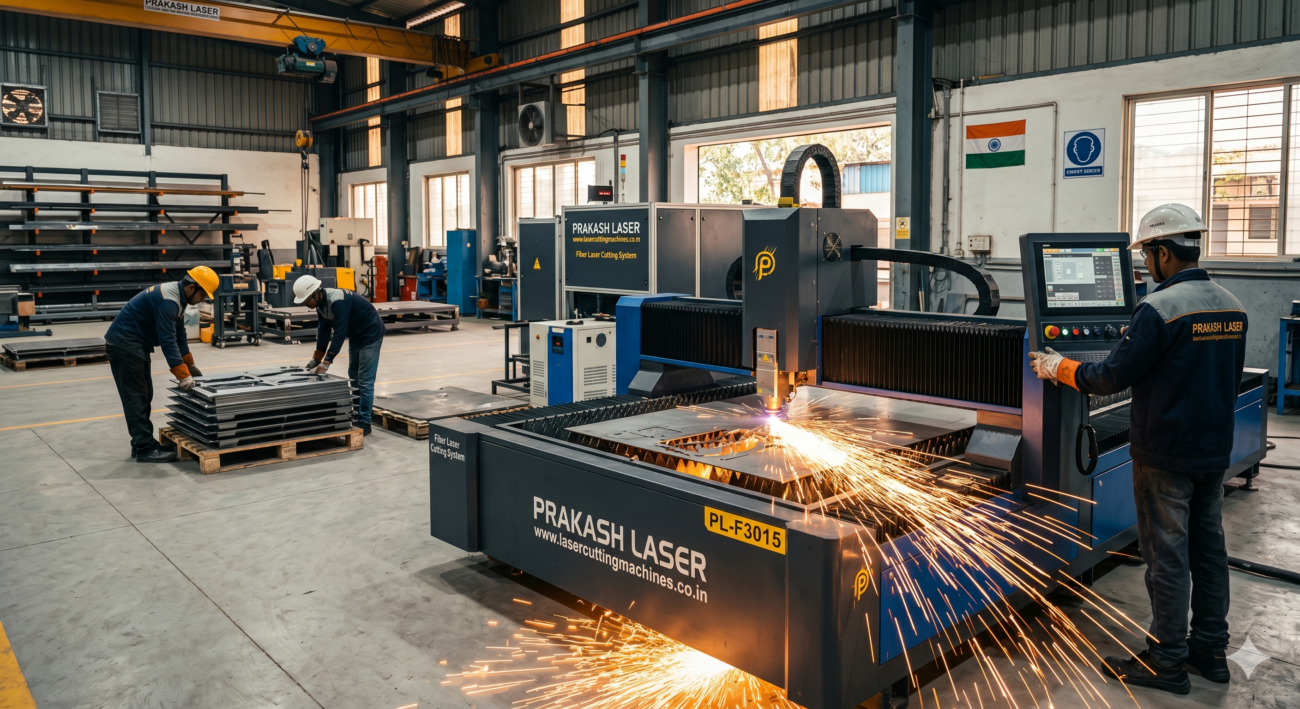
Fiber laser cutting machine have transformed metal fabrication across India. From automotive components and structural steel in Delhi to precision sheet metal parts in Pune and stainless-steel signage in Mumbai — the fiber laser is now the backbone of modern manufacturing. But to get the cleanest cuts, the least dross, and the best edge quality, you need to dial in the right settings for every material and thickness.
This comprehensive guide by Prakash Laser — one of India’s leading fiber laser cutting machine manufacturers — walks you through optimal power settings, cutting speeds, assist gas selection, and expert tips for cutting mild steel, stainless steel, aluminium, copper, and brass at various thicknesses.
1. Understanding the Key Parameters of Fiber Laser Cutting
Before diving into specific settings, it’s important to understand the four core variables that determine cut quality in fiber laser cutting:
- Laser Power (Watts): Higher power enables cutting thicker metals, but excess power causes melting and rough edges on thin sheets.
- Cutting Speed (mm/min): Faster speeds suit thinner materials; slower speeds are needed for thick metals to allow full penetration.
- Assist Gas & Pressure: Oxygen (O₂) for mild steel, Nitrogen (N₂) for stainless steel and aluminium — gas type and pressure directly impact cut quality and oxidation.
- Focus Position: The focal point of the laser beam must be precisely set relative to the material surface for each thickness.
- Nozzle Height (Stand-off Distance): Maintaining correct nozzle distance from the material ensures stable gas pressure and prevents collision.
| Pro Tip: Most fiber laser cutting machines in India come with built-in parameter libraries. Always start with the manufacturer’s baseline settings and fine-tune from there for your specific material batch and environment. |
2. Fiber Laser Cutting Machine Settings by Material & Thickness
The table below provides recommended starting settings for the most common metals cut by fiber laser machines in Indian manufacturing. These are general guidelines — exact values may vary based on your machine brand, laser source quality, and material grade.
| Material | Thickness | Power (W) | Speed (mm/min) | Assist Gas | Pressure (Bar) |
| Mild Steel | 1 mm | 500–750W | 4000–6000 | Oxygen (O₂) | 0.5–1.0 |
| Mild Steel | 3 mm | 1000–1500W | 2000–3500 | Oxygen (O₂) | 0.5–0.8 |
| Mild Steel | 6 mm | 2000–3000W | 1000–2000 | Oxygen (O₂) | 0.4–0.7 |
| Mild Steel | 10 mm | 3000–4000W | 500–1000 | Oxygen (O₂) | 0.3–0.6 |
| Mild Steel | 12 mm | 4000–6000W | 300–700 | Oxygen (O₂) | 0.3–0.5 |
| Stainless Steel | 1 mm | 500–750W | 5000–8000 | Nitrogen (N₂) | 8–12 |
| Stainless Steel | 3 mm | 1500–2000W | 2000–4000 | Nitrogen (N₂) | 10–15 |
| Stainless Steel | 6 mm | 3000–4000W | 800–1500 | Nitrogen (N₂) | 12–16 |
| Stainless Steel | 10 mm | 4000–6000W | 300–700 | Nitrogen (N₂) | 14–18 |
| Aluminium | 1 mm | 500W | 6000–10000 | Nitrogen (N₂) | 10–14 |
| Aluminium | 3 mm | 1500–2000W | 3000–5000 | Nitrogen (N₂) | 12–16 |
| Aluminium | 6 mm | 3000–4000W | 1000–2000 | Nitrogen (N₂) | 14–18 |
| Copper / Brass | 1 mm | 1000–1500W | 2000–4000 | Nitrogen (N₂) | 10–14 |
| Copper / Brass | 3 mm | 3000–4000W | 800–1500 | Nitrogen (N₂) | 12–16 |
Table: Recommended Fiber Laser Cutting Parameters by Material & Thickness (India Guide)
| ⚠ Important Note: These are starting reference values. Always run test cuts on a scrap piece of the same material batch before production cutting. Variables like material coating, surface rust, and ambient humidity in Indian workshops can affect results. |
3. Cutting Mild Steel: Tips for Best Results
Mild steel (MS) is the most common material cut by fiber laser machines in India, used extensively in fabrication, furniture, gates, and industrial equipment.
Thin Mild Steel (0.5 mm – 3 mm)
- Use Oxygen (O₂) as assist gas for clean oxidation cuts.
- Higher speeds (4000–8000 mm/min) prevent heat buildup and warping.
- Keep laser power moderate (500–1500W) — excess power burns through thin material.
- Focus position: at surface level (0 mm offset) or slightly below (–0.5 mm).
Medium Mild Steel (4 mm – 8 mm)
- Reduce speed significantly (1500–3000 mm/min) to allow full beam penetration.
- Increase O₂ pressure slightly to clear molten material from the kerf.
- 2000–3000W fiber lasers perform best in this range.
Thick Mild Steel (10 mm – 20 mm)
- Requires 4000W–6000W or higher fiber laser power.
- Very slow speeds (200–700 mm/min) — patience is key for quality cuts.
- Focus point should be shifted 1–2 mm below the surface (defocused into the material).
- Increase nozzle diameter (2.0–3.0 mm) for better gas flow and dross removal.
| Industry Insight: In India’s steel fabrication hubs like Ludhiana and Rajkot, 3000W–6000W fiber lasers have become the standard for cutting 6–16 mm mild steel in high-volume production. |
4. Cutting Stainless Steel: Achieving Bright, Oxide-Free Edges
Stainless steel demands Nitrogen (N₂) as the assist gas to prevent oxidation and achieve the bright, silvery edge finish required in food processing equipment, medical devices, and architectural applications.
- Always use Nitrogen at high pressure (8–18 bar) — low pressure causes yellow/brown oxidized edges.
- Nitrogen cutting is slower than oxygen cutting for the same thickness — factor this into production scheduling.
- For 304 and 316 grade SS, ensure the material surface is clean and free of oil/rust before cutting.
- Thin SS (1–2 mm): Very high speeds are achievable — up to 8000–12000 mm/min with 1000W laser.
- Thick SS (8–12 mm): Requires 4000W+ and slow speeds. Nitrogen consumption increases — ensure adequate gas supply.
| 💡 Cost-Saving Tip for Indian Fabricators: Nitrogen generator systems are increasingly popular in Indian factories cutting stainless steel. Instead of expensive cylinder nitrogen, an on-site N₂ generator at 99.9% purity can reduce assist gas costs by 60–70% for high-volume stainless cutting operations. |
5. Cutting Aluminium: Handling Reflectivity & Heat
Aluminium is highly reflective and thermally conductive — both properties that make it challenging for laser cutting. However, modern fiber lasers (1064 nm wavelength) are far better suited to aluminium than CO2 lasers, making aluminium laser cutting increasingly viable in India’s aerospace, automotive, and electronics sectors.
- Always use Nitrogen (N₂) — Oxygen causes rough, black oxidized cuts on aluminium.
- Reflectivity Risk: Older or low-quality fiber lasers without back-reflection protection can be damaged by aluminium. Ensure your machine has an optical isolator or back-reflection protection module.
- 1–3 mm aluminium: Very high speeds (6000–12000 mm/min) to prevent melting and material sticking.
- 6–10 mm aluminium: Requires higher power (3000–6000W) and much slower speeds.
- Surface Finish: For 5052 and 6061 alloys, clean the surface and use a protective film to prevent scratching during cutting.
| Note for Indian Buyers: If your production involves regular aluminium cutting of 6mm+, consider a 4000W or higher fiber laser machine. Many Indian SMEs underestimate power requirements and face poor quality cuts on thick aluminium. |
6. Cutting Copper & Brass: The High-Reflectivity Challenge
Copper and brass are among the most challenging materials for fiber laser cutting due to extreme reflectivity (copper reflects ~96% of laser energy). Despite this, modern high-power fiber lasers with advanced optics can cut copper and brass effectively.
- Use Nitrogen (N₂) for clean, oxide-free cuts — critical for electrical and plumbing applications.
- Start with maximum power even for thin sheets — copper needs high energy density to initiate cutting.
- Cutting speed must be tightly controlled — too fast causes incomplete cuts; too slow causes excessive melting.
- 1–2 mm copper/brass: 1000–2000W at moderate speeds (2000–4000 mm/min).
- 3–5 mm copper: Requires 4000W+ — consider specialized copper-optimized machines for high volumes.
- Always use protective glass covers on the laser head when cutting copper to protect against back-reflection damage.
| ⚠ Safety Warning: Brass cutting produces zinc fumes — always ensure proper fume extraction and ventilation in your workshop. This is especially important in Indian factory settings during summer when natural ventilation is reduced. |
7. Five Expert Tips to Improve Cut Quality at Any Thickness
Tip 1 — Run Test Cuts First
Before any production run, cut a small test grid at +/- 10% speed and power variations on the same material. Inspect for burr, dross, kerf width, and surface finish. This 10-minute test saves hours of rework.
Tip 2 — Keep Your Lens & Nozzle Clean
In Indian workshop environments — especially in dusty cities like Delhi NCR, Ludhiana, or Ahmedabad — contaminated optics are a leading cause of poor cut quality. Clean the protective window daily and replace it when transmission drops. Inspect the nozzle for spatter blockage.
Tip 3 — Calibrate Focus Regularly
The focal length changes with lens wear and temperature. Use your machine’s auto-focus feature or manually calibrate focus position using the focus paper test before each production shift.
Tip 4 — Optimize Pierce Parameters Separately
The pierce (initial puncture of the material) requires different parameters than through-cutting. Use lower power and longer pierce dwell time for thick materials to avoid spatter damage to the lens. Most modern CNC controllers allow separate pierce profiles.
Tip 5 — Account for Indian Power Supply Variations
Voltage fluctuations are common across Indian industrial areas. Install a servo voltage stabilizer for your fiber laser system. Even small power variations (±5%) can cause inconsistent cut quality, especially on critical medical or aerospace parts.
8. Common Fiber Laser Cutting Machine Defects & How to Fix Them
| Defect | Likely Cause | Fix |
| Dross / Burr | Wrong gas, pressure too low, speed too fast | Increase gas pressure, reduce speed, check nozzle alignment |
| Rough Cut Edge | Dirty lens, wrong focus, excessive power | Clean optics, recalibrate focus, reduce power |
| Incomplete Cut | Speed too fast, power too low, gas pressure insufficient | Slow down, increase power, check gas flow |
| Narrow Kerf / No Cut | Laser misaligned, lens damaged | Check beam alignment, inspect & replace lens |
| Burn / Overheating | Speed too slow, power too high for thin material | Increase speed, reduce power, use cooling pause |
| Striation Lines | Resonance in machine, worn linear guides | Check machine stability, lubricate guides, reduce speed |
Conclusion
Mastering fiber laser cutting settings for different metal thicknesses is part science, part experience. With the right combination of power, speed, gas selection, and focus calibration — and with a high-quality fiber laser cutting machine from a trusted Indian manufacturer — you can achieve consistent, professional-grade cuts across all metals and thicknesses.
At Prakash Laser, we have been helping Indian manufacturers, fabricators, and entrepreneurs find the right laser cutting solutions since 1994. Our fiber laser cutting machines are designed and optimized for Indian industrial conditions — from power supply variations to dusty environments — ensuring reliable, high-quality performance year after year.
Ready to upgrade your metal cutting capability? Contact Prakash Laser today at +91-9871377550 or visit www.lasercuttingmachines.co.in to explore our full range of fiber laser cutting machines and request a free sample demonstration.
One thought on “How to Cut Different Metal Thicknesses with a Fiber Laser Cutting Machine: Settings & Tips for Indian Manufacturers”
Comments are closed.